SWP Calculator 2026: Systematic Withdrawal Plan
Plan regular retirement income from your mutual fund investments. Estimate how long your corpus will last with fixed monthly payouts and compounded expected returns.
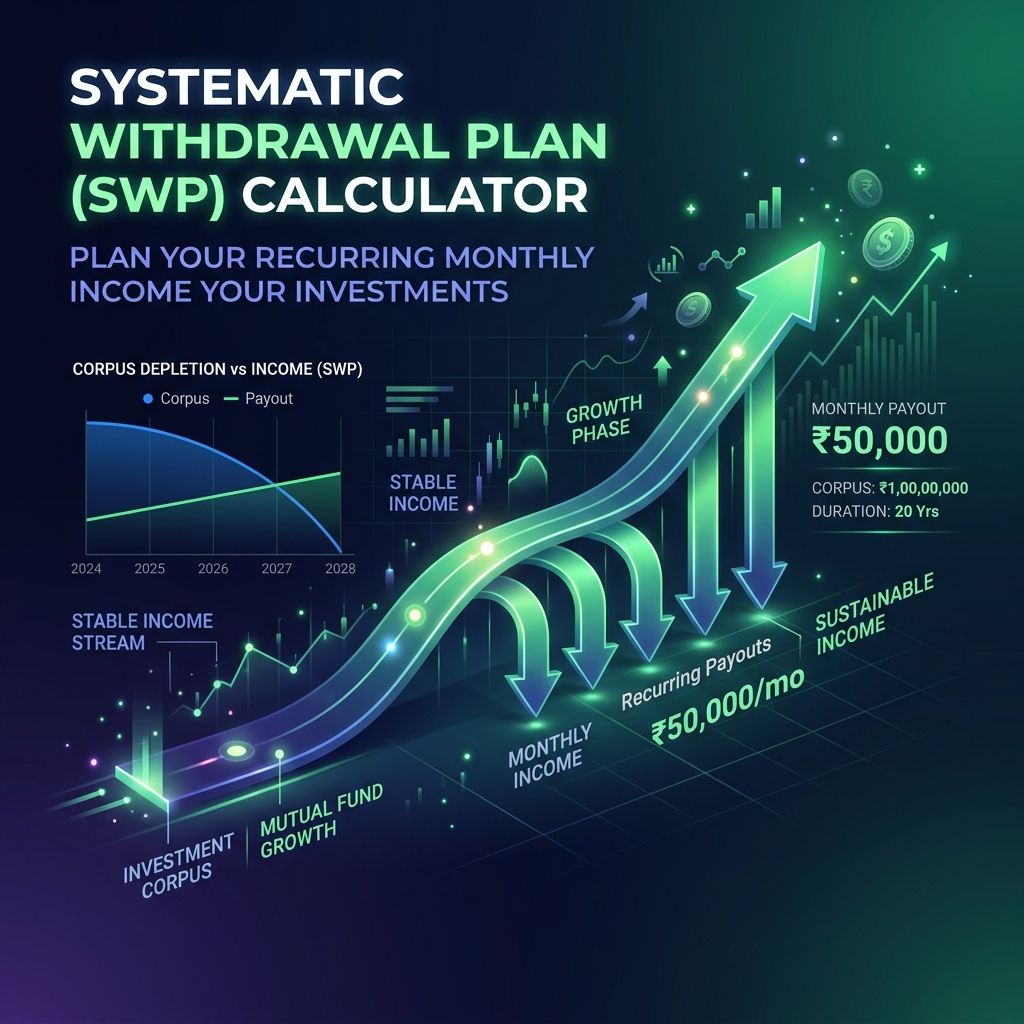
SWP Payout & Growth Estimator
Enter your initial corpus, monthly withdrawal amount, expected rate of return, and total years to calculate the future value of your portfolio.
SWP Corpus Simulation
Retirement & Regular Income Planner
SWP Year-by-Year Growth Ledger
Below is the step-by-step breakdown of your portfolio. You can see the opening balance, estimated interest earned during the year, payouts made, and the closing balance.
| Year | Opening Balance | Interest Added | Total Payouts | Closing Balance |
|---|---|---|---|---|
| 1 | ₹10,00,000 | +₹1,20,000 | -₹1,20,000 | ₹10,00,000 |
| 2 | ₹10,00,000 | +₹1,20,000 | -₹1,20,000 | ₹10,00,000 |
| 3 | ₹10,00,000 | +₹1,20,000 | -₹1,20,000 | ₹10,00,000 |
| 4 | ₹10,00,000 | +₹1,20,000 | -₹1,20,000 | ₹10,00,000 |
| 5 | ₹10,00,000 | +₹1,20,000 | -₹1,20,000 | ₹10,00,000 |
| 6 | ₹10,00,000 | +₹1,20,000 | -₹1,20,000 | ₹10,00,000 |
| 7 | ₹10,00,000 | +₹1,20,000 | -₹1,20,000 | ₹10,00,000 |
| 8 | ₹10,00,000 | +₹1,20,000 | -₹1,20,000 | ₹10,00,000 |
| 9 | ₹10,00,000 | +₹1,20,000 | -₹1,20,000 | ₹10,00,000 |
| 10 | ₹10,00,000 | +₹1,20,000 | -₹1,20,000 | ₹10,00,000 |
| 11 | ₹10,00,000 | +₹1,20,000 | -₹1,20,000 | ₹10,00,000 |
| 12 | ₹10,00,000 | +₹1,20,000 | -₹1,20,000 | ₹10,00,000 |
| 13 | ₹10,00,000 | +₹1,20,000 | -₹1,20,000 | ₹10,00,000 |
| 14 | ₹10,00,000 | +₹1,20,000 | -₹1,20,000 | ₹10,00,000 |
| 15 | ₹10,00,000 | +₹1,20,000 | -₹1,20,000 | ₹10,00,000 |
What is a Systematic Withdrawal Plan (SWP)?
A Systematic Withdrawal Plan (SWP) is a structured financial strategy offered by asset management companies (mutual fund houses) that allows investors to withdraw a predetermined sum of money from their existing mutual fund investments at regular intervals (monthly, quarterly, semi-annually, or annually).
Unlike a Systematic Investment Plan (SIP), which facilitates wealth accumulation by routing recurring investments *into* mutual funds, an SWP does the exact opposite. It facilitates controlled wealth decumulation, serving as a reliable mechanism to convert accumulated mutual fund corpuses into consistent, regular cash flows. This makes it an ideal instrument for senior citizens seeking retirement income, individuals on career breaks, or anyone looking for a steady monthly paycheck from their investment assets.
How SWP Works in Mutual Funds: The Mechanics of Unit Redemption
Understanding the mechanical workflow of an SWP is critical to maximizing its benefits. When you initiate an SWP, the fund house does not simply distribute interest like a traditional bank fixed deposit (FD). Instead, it redeems a specific amount of mutual fund units from your existing portfolio on the designated date each month.
The number of units redeemed depends directly on the prevailing **Net Asset Value (NAV)** of the fund on that withdrawal date.
Redeemed Units Formula:
Units Redeemed = Monthly Withdrawal Amount ÷ Current Fund NAV
Let’s look at a practical demonstration of how this plays out in volatile market conditions:
- Scenario A (Bull Market): If your monthly withdrawal is ₹20,000 and the fund NAV is ₹100, the fund house redeems exactly **200 units** from your account.
- Scenario B (Bear Market): If the market drops and the fund NAV declines to ₹80, the fund house must redeem **250 units** to generate the same ₹20,000 payout.
- Remaining Growth: The units that remain in your account continue to experience market compounding. If the long-term compounded growth of the NAV exceeds the withdrawal rate, your total corpus can actually grow in value over time, despite your monthly payouts.
The Mathematics of SWP: Capital Preservation and Decumulation
An SWP is a balance of two opposing forces: compounding growth (which increases your money) and systematic withdrawals (which deplete it).
The mathematically generalized formula to determine the remaining balance $A$ after a series of regular withdrawals under compound returns is:
A = P * (1 + r)^n – W * [ ( (1 + r)^n – 1 ) / r ]
Where:
A: Remaining corpus value after N periods
P: Initial lumpsum investment (starting corpus)
r: Monthly expected rate of return (Annual Rate ÷ 12 ÷ 100)
n: Total number of compounding periods in months (Years × 12)
W: Monthly withdrawal amount
If the monthly return rate ($r \times P$) is larger than or equal to $W$, the remaining balance will grow indefinitely. If $W$ is larger than the returns generated, the corpus will slowly deplete until it eventually reaches zero. Managing the relationship between your withdrawal rate and your expected rate of return is the key to creating a sustainable retirement payout plan.
SWP vs. SIP vs. Lumpsum: A Comparative Matrix
To choose the right investment path, you should understand where each mechanism fits in your financial lifecycle:
| Feature | SIP (Systematic Investment) | Lumpsum (One-Time) | SWP (Systematic Withdrawal) |
|---|---|---|---|
| Primary Goal | Wealth accumulation over time | One-time wealth placement | Steady, periodic income generation |
| Cash Flow Direction | Investor pays monthly into the fund | Investor pays a single big sum upfront | Fund pays investor monthly/quarterly |
| Ideal Market Condition | Volatile or falling markets (rupee cost averaging) | Rising markets (bull phase) | Stable, long-term growing markets |
| Best For | Salaried individuals saving monthly | Investors with surplus bonus/windfalls | Retirees, freelancers, pension planning |
Strategic Benefits of Systematic Withdrawal Plans
Experienced financial planners often recommend SWPs over standard dividend payout plans (IDCW) or fixed-income bank alternatives. The primary reasons include:
- Rupee Cost Averaging in Reverse:Although withdrawing in a falling market means selling more units, staying invested ensures that during a bull run, the remaining units gain value rapidly. This active market participation helps the corpus outpace inflation far better than bank savings accounts.
- Customizable Payouts:Unlike conventional pension schemes where payouts are locked, SWPs allow you to change, pause, stop, or top up the monthly withdrawal amount as per your evolving financial obligations.
- High Tax Efficiency:This is the single biggest advantage of SWP. Instead of taxing the entire monthly payout, the tax authorities only tax the **capital gains component** of the redeemed units.
SWP Taxation Rules in India (FY 2025-26 & 2026)
The tax treatment of SWPs is vastly superior to Bank Fixed Deposits or Senior Citizen Savings Schemes (SCSS) because it is subject to mutual fund capital gains rules. Here is a breakdown of the rules applicable for the current financial year:
1. Equity-Oriented Mutual Funds (Equity exposure > 65%)
If your SWP withdrawals are set up in equity mutual funds:
- Short-Term Capital Gains (STCG): If units are redeemed within 1 year of purchase, the gains are taxed at a flat rate of **20%**.
- Long-Term Capital Gains (LTCG): If units are redeemed after a holding period of 1 year, gains are taxed at **12.5%**. Most importantly, LTCG up to **₹1.25 Lakh per financial year** is completely exempt from tax across all equity investments combined.
2. Debt Mutual Funds
For debt-oriented funds (equity exposure < 35%):
- All gains from redemptions are treated as short-term capital gains, regardless of the holding period. These gains are added directly to your taxable income and taxed at your prevailing **income tax slab rate** (up to 30% + surcharge).
SWP Tax Arbitrage Example
If you withdraw ₹50,000 monthly from a bank FD, the entire ₹50,000 interest is taxable every year at your slab rate. But if you withdraw ₹50,000 monthly from an equity SWP, only a small fraction represents capital gains (e.g. ₹5,000 gain + ₹45,000 principal return). Thus, you pay tax on only ₹5,000 of capital gains, leading to massive tax savings.
Frequently Asked Questions (FAQs)
Is SWP safe for long-term retirement planning?
SWPs in mutual funds are subject to market risks. To make them safe, retirees should invest in low-to-moderate volatility funds, such as hybrid funds, conservative asset allocation funds, or large-cap funds. Setting a conservative withdrawal rate (under 6% p.a.) also protects the corpus during market downturns.
What is a “safe withdrawal rate” for SWP?
Typically, a withdrawal rate of 4% to 6% per annum of the initial investment is considered safe. For example, if you invest ₹1 Crore, withdrawing ₹4 Lakhs to ₹6 Lakhs a year (₹33,000 to ₹50,000 per month) ensures your corpus will likely last for 25+ years or grow indefinitely, depending on market performance.
Can I change my SWP withdrawal amount or date later?
Yes, absolutely. SWP is highly flexible. You can request the fund house to increase, decrease, or temporarily pause your withdrawals at any time. You can also modify the date of your monthly withdrawal without any penalties.
Is TDS deducted on SWP withdrawals?
For Indian resident individuals, there is no Tax Deducted at Source (TDS) on mutual fund withdrawals, whether equity or debt. You must report your capital gains in your annual Income Tax Return (ITR) and pay tax accordingly. TDS is applicable only for NRI (Non-Resident Indian) investors.
What is the difference between SWP and Mutual Fund Dividends (IDCW)?
Dividends (now called IDCW) are paid at the discretion of the fund house and are not guaranteed in value or timing. Also, dividend income is taxed at your full slab rates. SWP offers fixed, guaranteed monthly payouts on dates chosen by you, and has much higher tax efficiency.
Can I stop my SWP at any time?
Yes, you can cancel or stop your SWP at any point by submitting a request online or physically to the mutual fund house (takes about 7 to 10 working days to process). The remaining units in your mutual fund scheme will continue to grow as normal without any systematic redemptions.
Can I invest in SWP using a stock portfolio directly?
Yes, some modern brokerages allow you to set up automated sell orders on a stock basket to simulate an SWP. However, doing so manually or via automated stock sales is subject to the same capital gains tax rules and requires careful manual rebalancing compared to professional mutual fund SWP schemes.
What happens to the SWP corpus in the event of the investor’s death?
In the unfortunate event of the investor’s demise, the SWP stops. The remaining units in the mutual fund folio are transferred to the registered nominee or legal heir, who can then choose to withdraw the lumpsum or start a new SWP in their own name.

Rohit Kushwaha
Software Engineer & Creator of mysalarycalculator.in
I’m Rohit Kushwaha, a Software Engineer with 3+ years of experience in developing web applications and digital solutions. By combining technology with practical financial tools, I built mysalarycalculator.in to help Indian professionals easily understand their salary, taxes, EPF, gratuity, and take-home income.
Ask a question or share your feedback