RD Calculator 2026: Recurring Deposit Interest Online
Calculate your Recurring Deposit (RD) maturity amount and interest returns online using bank-standard quarterly compounding rules. Update interest rates for 2026.
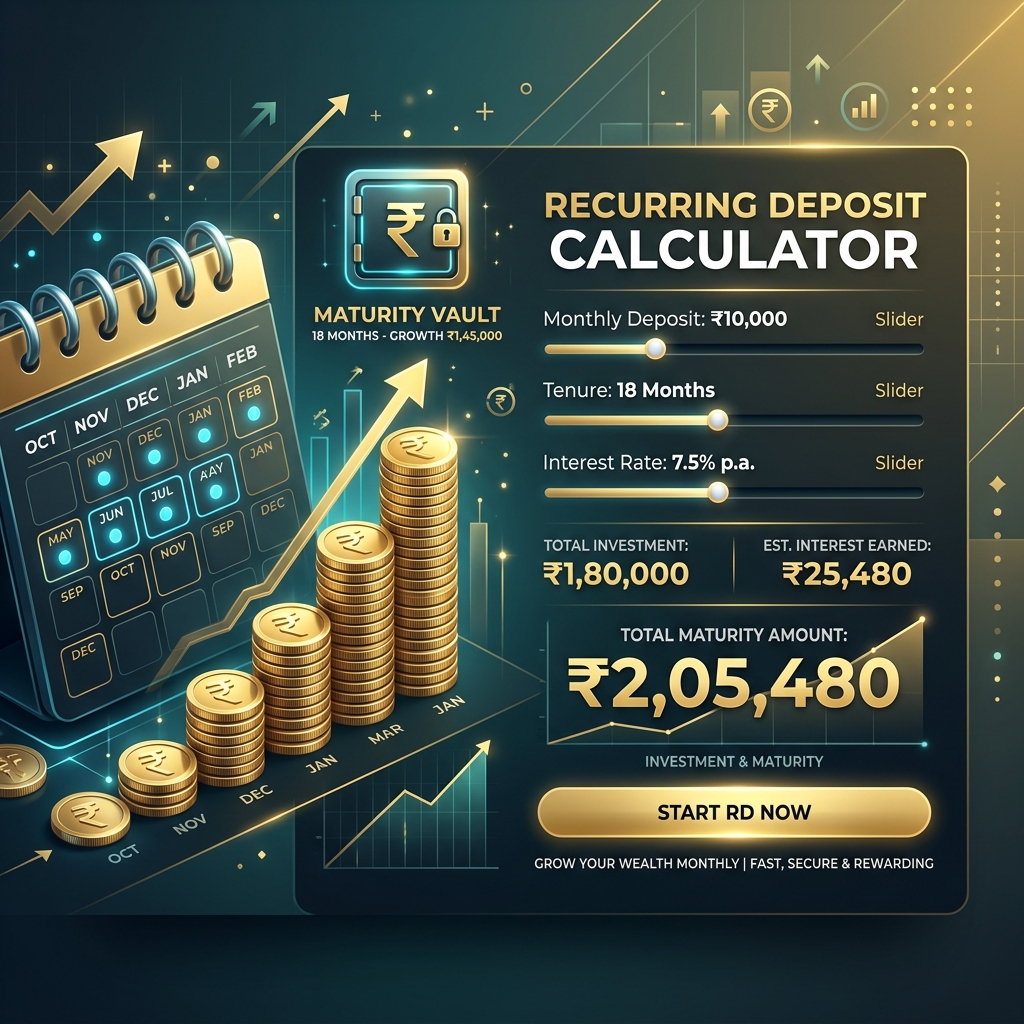
Recurring Deposit Maturity Calculator
Adjust the sliders below to calculate the interest yield and the final maturity amount of your recurring deposits.
Recurring Deposit (RD)
Quarterly Compounding Estimator
Year-by-Year Savings Ledger
Here is how your monthly savings build compounding interest. See your deposits accrue and compounding take effect year-on-year.
| Year | Opening Balance | Yearly Deposits | Interest Credited | Closing Balance |
|---|---|---|---|---|
| 1 | ₹0 | ₹60,000 | +₹2,311 | ₹62,311 |
| 2 | ₹62,311 | ₹60,000 | +₹6,788 | ₹1,29,099 |
| 3 | ₹1,29,099 | ₹60,000 | +₹11,587 | ₹2,00,686 |
| 4 | ₹2,00,686 | ₹60,000 | +₹16,732 | ₹2,77,418 |
| 5 | ₹2,77,418 | ₹60,000 | +₹22,246 | ₹3,59,664 |
What is a Recurring Deposit (RD)?
A Recurring Deposit (RD) is a popular and low-risk investment tool offered by banking institutions and post offices across India. It allows investors to make regular, fixed monthly contributions over a specified term (typically ranging from 6 months to 10 years). In return, banks provide a guaranteed interest rate that is compounded quarterly and paid out at maturity.
Unlike a Fixed Deposit (FD) which requires a large, upfront lump-sum capital investment, RDs are designed for salaried individuals and monthly budgeters. By routing small monthly savings into a recurring deposit, you build a disciplined savings habit while earning rates that are identical to fixed deposits. RDs represent an excellent option for building short-term emergency corpuses, planning yearly premiums, or funding immediate goals like travel, education, or weddings.
How is Recurring Deposit Interest Calculated in India?
In India, banking institutions calculate RD maturity amounts using standard formulas recommended by the Indian Bank Association (IBA). Unlike simple interest, RDs compound interest quarterly. The compounding effect works chronologically: your first monthly installment earns interest for the full duration of your tenure, while subsequent deposits earn interest for progressively shorter periods.
The official IBA formula utilized by banks to determine the final maturity value is:
M = R * [ ( (1 + i)^n – 1 ) / ( 1 – (1 + i)^(-1/3) ) ]
Where:
M: Maturity Value of the Recurring Deposit
R: Monthly installment deposit amount
i: Quarterly interest rate (Annual Interest Rate ÷ 4 ÷ 100)
n: Number of quarters in the tenure (Tenure in Years × 4)
Step-by-Step Mathematical Example:
Suppose you set up an RD of **₹1,000 per month** at an interest rate of **7.1% per annum** for a period of **5 years** (which translates to 20 quarters). Let’s compute the maturity amount:
- Calculate quarterly interest rate (i):
i = 7.1 ÷ 400 = 0.01775 - Compute quarters (n):
n = 5 years × 4 = 20 quarters - Solve upper compound factor:
(1 + i)^n = (1.01775)^20 ≈ 1.420846 - Calculate numerator:
(1 + i)^n – 1 = 1.420846 – 1 = 0.420846 - Calculate denominator:
1 – (1 + i)^(-1/3) = 1 – (1.01775)^(-0.333333) ≈ 1 – 0.994178 = 0.005822 - Calculate Maturity Value (M):
M = 1,000 × (0.420846 ÷ 0.005822) ≈ ₹72,285
Through this calculation, you invest a total of **₹60,000** (₹1,000 × 60 months) and receive a final maturity value of **₹72,285**, earning a guaranteed interest yield of **₹12,285**.
Recurring Deposit (RD) vs. Fixed Deposit (FD) vs. Mutual Fund SIP
Selecting the ideal savings channel is simpler when you compare the risk, return profiles, and structures of these three popular instruments:
| Feature | Recurring Deposit (RD) | Fixed Deposit (FD) | Systematic Investment Plan (SIP) |
|---|---|---|---|
| Investment Style | Regular monthly contributions | One-time lumpsum placement | Periodic (usually monthly) mutual fund buys |
| Risk Level | Very Low (Guaranteed by banks/government) | Very Low (Guaranteed by banks/government) | Moderate to High (Subject to market volatility) |
| Interest Rates | Fixed (6.0% – 7.5% per annum) | Fixed (6.5% – 8.0% per annum) | Variable (Typically 12% – 15% long-term returns) |
| Taxability | Taxed at slab rates (Interest added to income) | Taxed at slab rates (Interest added to income) | Capital gains tax rules (12.5% for long term equity) |
| Ideal For | Disciplined savings for short-term goals | Investing sudden surplus or windfall sums | Long-term wealth creation (5+ years) |
Latest Bank RD Interest Rates 2026
RD interest rates are tied to the corresponding bank fixed deposit interest rates. In 2026, most scheduled public and private sector banks offer interest rates ranging from **6.00% to 7.50%** for regular depositors, with an additional **0.50% markup for Senior Citizens**. Here is an indicative rate list:
- State Bank of India (SBI): 6.80% to 7.00% p.a. (Senior Citizens: 7.30% to 7.50% p.a.)
- HDFC Bank & ICICI Bank: 6.75% to 7.25% p.a. (Senior Citizens: 7.25% to 7.75% p.a.)
- Post Office Recurring Deposit (5-Year): 6.70% p.a. (Quarterly compounding, backed by the Government of India)
- Small Finance Banks (Ujjivan, Unity, Equitas): Up to 8.25% p.a. (Senior Citizens: Up to 8.75% p.a.)
Tax Rules and TDS Implications on Recurring Deposits (2026)
Many investors mistakenly believe that RDs are tax-free because payouts only occur at maturity. However, tax rules in India treat RD interest identical to FD interest:
- Income Tax Slab: The interest accrued on your RD is added directly to your gross salary or annual income and is taxed under the head “Income from Other Sources” at your prevailing slab rates (5%, 10%, 15%, 20%, or 30%).
- TDS Limits: Under Section 194A, banks will deduct TDS at **10%** if the total interest earned across your deposits (FDs + RDs) in a bank branch exceeds **₹40,000** in a financial year (the limit is **₹50,000** for Senior Citizens). If you have not updated your PAN with the bank, the TDS deduction rate rises to **20%**.
- Form 15G/15H: If your total annual taxable income falls below the minimum tax-exempt limit (e.g. ₹7,00,000 under the New Tax Regime), you can submit Form 15G (Form 15H for senior citizens) to your bank at the start of the fiscal year to prevent TDS deduction.
Tax Exemptions under Section 80C
Standard bank RDs do not offer any tax deductions. However, the **5-Year Post Office Recurring Deposit** is eligible for tax exemption under Section 80C of the Income Tax Act, allowing deductions up to ₹1.5 Lakhs per financial year on your deposits.
Frequently Asked Questions (FAQs)
Can I withdraw my RD funds prematurely before maturity?
Yes, most banks allow you to close your Recurring Deposit before its designated maturity date. However, doing so will attract a premature withdrawal penalty, typically ranging from 0.5% to 1.0% deduction from the interest rate applicable for the period the deposit remained with the bank.
What happens if I miss a monthly RD installment payment?
If you fail to pay your monthly RD installment on time, banks usually allow a grace period of a few days. If the delay persists, banks levy a small penalty (e.g., ₹1.50 per ₹100 of monthly deposit per month). If you miss payments consecutively for 4 to 6 months, the bank reserves the right to close your RD account.
Do senior citizens get higher interest rates on Recurring Deposits?
Yes, almost all scheduled banks in India offer senior citizens (aged 60 and above) an additional markup of 0.50% (sometimes up to 0.75%) p.a. over the standard interest rate. This makes RDs an attractive guaranteed income feeder for senior citizens.
Is compounding for Recurring Deposits done monthly or quarterly?
By bank rules in India, Recurring Deposit interest is compounded quarterly. This means interest calculations are performed every 3 months, and the interest accrued is added to the principal to compound further.
Is Post Office RD better than Bank RDs?
Post Office RDs are 100% safe as they are backed by the government. The Post Office 5-Year RD offers a competitive interest rate and benefits under Section 80C. However, bank RDs offer higher flexibility with shorter tenures (from 6 months) whereas Post Office RDs have a mandatory lock-in period of 5 years.
Can I change my monthly RD deposit amount mid-tenure?
No. The monthly installment amount is fixed at the time of opening the Recurring Deposit and cannot be altered or revised during the entire tenure of the deposit.
What is the minimum amount required to open an RD in India?
For most public sector banks and post offices, the minimum monthly installment can be as low as ₹100. For top private banks, the minimum installment starts at ₹500 or ₹1,000 per month.
Can the interest rate of my RD change after I open it?
No. The rate of interest is locked at the time you open the Recurring Deposit. It remains fixed and unchanged throughout the tenure of your RD, shielding you from any subsequent rate cuts in the banking sector.

Rohit Kushwaha
Software Engineer & Creator of mysalarycalculator.in
I’m Rohit Kushwaha, a Software Engineer with 3+ years of experience in developing web applications and digital solutions. By combining technology with practical financial tools, I built mysalarycalculator.in to help Indian professionals easily understand their salary, taxes, EPF, gratuity, and take-home income.
Ask a question or share your feedback