Simple Interest Calculator 2026: Flat Rate Interest online
Calculate the simple interest (SI) accrued on your savings, short-term bank deposits, or student borrowings with exact year-by-year schedules.
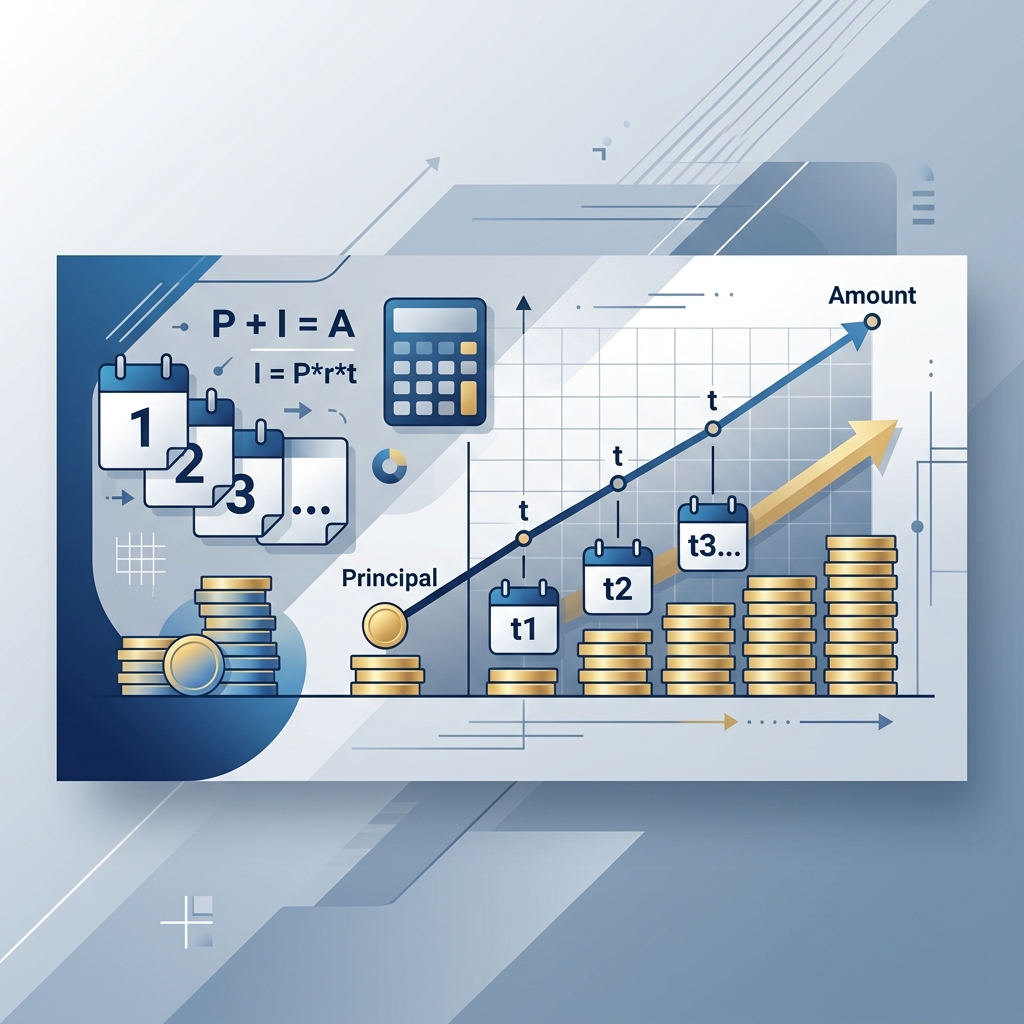
Flat Rate Interest
Interest is calculated only on the initial principal, not on accumulated interest.
Short-Term Utility
Commonly used for gold loans, short-term bonds, and private commercial bills.
Linear Growth
Earnings grow in a straight line, making payouts predictable and easy to model.
Interactive Flat Interest Modeler
Simple Interest Modeler
Flat Compounding Method
Simple Interest Calculator: A Complete Educational Guide
Interest calculation is one of the oldest and most fundamental concepts in finance. Whether you are depositing your hard-earned savings into a bank account, investing in short-term government bills, borrowing commercial capital, or solving mathematics problems at school, understanding how interest accrues is critical.
Interest generally falls into two categories: **Simple Interest** and **Compound Interest**. While compound interest is the standard for long-term investments, simple interest remains an essential metric for short-term lending, gold loans, student borrowings, and private commercial agreements. By using our **Simple Interest Calculator 2026**, you can instantly compute flat interest payouts, calculate total maturity value, and view year-by-year linear schedules.
1. What is Simple Interest?
Simple Interest (SI) is a quick and straightforward method of calculating the interest charge on a loan or the earnings on a savings deposit. In a simple interest setup, the interest is computed **only on the original principal amount** (the initial sum of money borrowed or invested).
Key characteristics of Simple Interest include:
- Flat Earnings: The interest amount earned or charged remains exactly the same in every period (yearly, monthly, daily), assuming the interest rate does not change.
- No Compounding: Unlike compound interest, you do not earn interest on your interest. The accumulated interest does not get added back to the principal to form a new base for the next period.
2. The Mathematics: How is Simple Interest Calculated?
Calculating simple interest relies on a standard mathematical formula:
SI = ( P × R × T ) / 100
Where:
• SI: Simple Interest
• P: Principal Amount (the initial sum borrowed or deposited)
• R: Rate of Interest per Annum (annual percentage rate)
• T: Time Period (in years)
Step-by-Step Practical Calculation Example:
Let us assume you invest ₹1,00,000 in a short-term corporate bond that offers an annual interest rate of 8% p.a. simple interest for a tenure of 5 years.
- Identify parameters:
P = 1,00,000,R = 8,T = 5. - Apply values to the formula:
SI = (1,00,000 × 8 × 5) / 100 - Multiply the numerator:
1,00,000 × 8 × 5 = 40,00,000 - Divide by 100:
SI = 40,00,000 / 100 = ₹40,000. - Calculate Total Value (Maturity Amount):
Total Value = Principal + SI = 1,00,000 + 40,000 = ₹1,40,000.
In this scenario, your investment earns exactly ₹8,00,000 × 8 / 100 = ₹8,000 in interest every year. By the end of Year 5, your total simple interest accrued is ₹40,000.
3. Simple Interest vs. Compound Interest: The Compounding Gap
While simple interest is calculated only on the initial principal, compound interest is calculated on the principal plus all interest accumulated in previous periods. Albert Einstein famously called compound interest the “eighth wonder of the world.”
Let’s compare the growth of ₹1,00,000 at 8% p.a. under both simple and compound interest (compounded annually) over a 20-year period:
- Simple Interest: The investment grows by a flat ₹8,000 every year. After 20 years, the total interest earned is
₹8,000 × 20 = ₹1,60,000, bringing the total value to ₹2,60,000. - Compound Interest: The interest earned in Year 1 (₹8,000) is added to the principal, so in Year 2, you earn interest on ₹1,08,000. After 20 years, the investment compounds to ₹4,66,096 (earning ₹3,66,096 in interest).
The difference — **₹2,06,096** — represents the compounding gap. This is why for long-term savings and pension planning, compound interest is far superior. However, for short-term transactions, simple interest is preferred due to its simplicity and transparency.
4. Common Applications of Simple Interest in India
Although compounding dominates the banking sector, simple interest is still actively utilized in several financial services in India:
- Gold Loans: Many public and private lenders compute interest on gold loans on a flat/simple interest basis. Borrowers pay back the principal and accumulated simple interest at the end of the tenure.
- Short-Term Deposits: Fixed deposits (FDs) with a tenure of less than 6 months usually pay simple interest on maturity instead of compounding quarterly.
- Government / Corporate Bonds: Many corporate debt papers and government treasury bills distribute interest (coupons) periodically based on flat simple interest on the face value.
- Education Loans: During the “moratorium period” (the course duration plus study extension before repayment begins), banks calculate simple interest on the disbursed loan amount.
Frequently Asked Questions (FAQs)
What is the formula for calculating Simple Interest?
The standard formula is SI = (P × R × T) / 100, where P is the Principal amount, R is the annual Interest Rate (%), and T is the Time period in years.
How do you calculate simple interest if the time period is in months?
If the tenure is in months, convert it to years by dividing the number of months by 12. E.g., for 18 months, T = 18 / 12 = 1.5 years. Then apply T = 1.5 in the SI formula.
How do you calculate simple interest if the time period is in days?
If the tenure is in days, convert it to years by dividing by 365 (or 366 in leap years). E.g., for 73 days, T = 73 / 365 = 0.2 years. Then plug T = 0.2 into the formula.
Are fixed deposits (FD) in India calculated using simple or compound interest?
Most fixed deposits in India with tenures of 6 months or more compound interest quarterly. However, short-term fixed deposits (tenures less than 6 months) pay simple interest at maturity. Post Office recurring deposits and savings accounts also calculate interest differently.
Are simple interest earnings taxable in India?
Yes, interest earned through simple interest vehicles (like bank savings accounts, short-term FDs, and bonds) is treated as “Income from Other Sources” and taxed as per your individual tax slab. Under Section 80TTA, individuals can claim a deduction up to ₹10,000 on interest earned from savings bank accounts.
What is the difference between Simple Interest and Compound Interest?
Simple interest is calculated only on the initial principal. Compound interest is calculated on the principal plus all interest earned in previous periods, meaning you earn interest on your interest.
Can simple interest be applied to credit card bills?
No, credit cards do not use simple interest. If you carry a balance on your credit card, interest is compounded daily on the outstanding amount and any new purchases, leading to rapid debt build-up. Always pay your full credit card balance to avoid these high compound charges.
How do leap years affect daily simple interest calculations?
In a leap year, banks divide the days by 366 instead of 365 to calculate the daily interest rate. Some private contracts specify a flat 365-day year for interest calculations regardless of leap years.

Rohit Kushwaha
Software Engineer & Creator of mysalarycalculator.in
I’m Rohit Kushwaha, a Software Engineer with 3+ years of experience in developing web applications and digital solutions. By combining technology with practical financial tools, I built mysalarycalculator.in to help Indian professionals easily understand their salary, taxes, EPF, gratuity, and take-home income.
Ask a question or share your feedback