CTC to In-Hand Salary Calculator India (FY 2025-26)
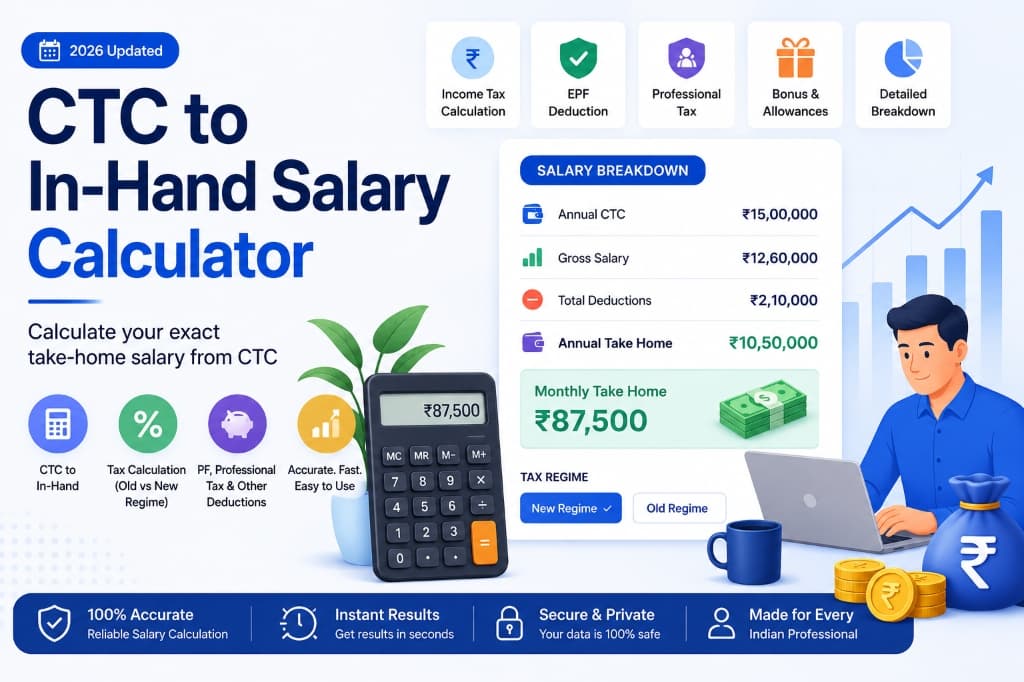
Instantly calculate your monthly net take-home salary from your annual Cost to Company (CTC) package. Compare calculations under the Old & New Tax Regimes for FY 2025-26.
Salary Details
Under the new Labour Codes (2025), Basic Pay + DA must be at least 50% of the total CTC.
📊 Detailed CTC to In-Hand Salary Breakdown
| Salary Component | Monthly (Rs.) | Annual (Rs.) |
|---|---|---|
| Cost to Company (CTC) | ₹1,25,000 | ₹15,00,000 |
| Basic Salary (Base pay) | ₹62,500 | ₹7,50,000 |
| Employer PF Contribution | -₹1,800 | -₹21,600 |
| Gratuity Provision (4.81% of Basic) | -₹3,006 | -₹36,075 |
| Gross Salary (Before Tax & Employee PF) | ₹1,20,194 | ₹14,42,325 |
| Employee PF Contribution | -₹1,800 | -₹21,600 |
| Professional Tax (PT) | -₹200 | -₹2,400 |
| Income Tax (Est. TDS) | -₹7,344 | -₹88,128 |
| Performance Bonus (Excluded from monthly net) | -₹12,500 | -₹1,50,000 |
| Net Take-Home Salary (Monthly Fixed In-Hand) | ₹98,350 | ₹11,80,197 |
| Total Annual Take-Home (Including Bonus) | ₹1,10,850 | ₹13,30,197 |
CTC vs Gross vs Net Salary
CTC Share breakdown
Understanding CTC vs In-Hand Salary: What It Really Means
When you secure a new job or undergo an annual performance review, the headline figure you receive is typically your Cost to Company (CTC). It is common to feel a sense of excitement seeing a high number, only to face confusion when the first monthly pay slip arrives and the actual amount credited to your bank account is far less. This gap is the difference between your gross CTC package and your liquid, monthly in-hand take-home salary.
CTC represents the total financial outflow an employer allocates to keep you on the payroll. This encompasses not just your monthly cash pay, but also long-term retirement contributions (like Provident Fund and Gratuity), insurance premiums, medical benefits, and variable bonuses. Many of these elements do not show up in your monthly bank transfers. Our online CTC to in-hand salary calculator helps you navigate this complex structure, allowing you to estimate your real take-home pay with precision.
The Crucial Differences: CTC, Gross Salary, and Net In-Hand
To demystify your salary slip, you must understand the mathematical progression from CTC to Gross, and finally to Net In-Hand:
The complete annual package. Includes cash salary, allowances, employer's retirement contributions (PF, Gratuity), and variable bonuses.
Gross Salary = CTC − Employer EPF − Gratuity ProvisionGross salary represents your total earnings before employee deductions (PF, Professional Tax, and Income Tax TDS) are subtracted.
Net Monthly In-Hand = (Gross Salary − Employee EPF − Professional Tax − Income Tax TDS) ÷ 12This is the final, liquid cash deposited into your bank account each month, excluding variable performance bonuses which are typically paid out quarterly or annually.
Key Salary Components and the 2025 Labour Code 50% Rule
Every salary structure in India consists of multiple statutory and allowance-based components. Knowing how they affect taxability and your take-home pay is vital:
- Basic Salary: This is the core portion of your compensation structure. Under the new Labour Codes (implemented in November 2025), Basic Salary combined with Dearness Allowance (DA) must constitute at least 50% of your total CTC. This has significantly impacted payroll designs, leading to higher long-term retirement contributions (EPF and Gratuity) and slightly reducing monthly cash in-hand.
- House Rent Allowance (HRA): HRA helps cover rental accommodation expenses. Salaried employees under the Old Tax Regime can claim HRA tax exemption under Section 10(13A). The exempt amount is the minimum of:
• Actual HRA received• 50% of Basic salary (for metros: Mumbai, Delhi, Kolkata, Chennai) or 40% (for non-metros)• Actual rent paid minus 10% of Basic salary - Employee Provident Fund (EPF): A statutory retirement savings plan. Both the employer and employee contribute 12% of the basic salary each month to the EPFO. The employer's portion is deducted from CTC, while the employee's share is deducted from Gross Salary. Many organizations offer the option to cap the EPF base at the statutory limit of ₹15,000 per month (restricting the monthly deduction to ₹1,800), which helps maximize your current monthly in-hand salary.
- Gratuity: Gratuity is a statutory terminal benefit paid to employees upon completing 5 years of continuous service. It is computed as 4.81% of the annual basic salary (or 15 days of wages for every completed year of service). Employers include this as a cost component in your annual CTC package.
- Professional Tax (PT): A small state-level tax levied on salaried professionals. In most states, it is capped at a maximum of ₹2,500 per year (typically ₹200 per month).
- Special / Flexi Allowances: A balancing component used to build the rest of your salary package. These allowances are fully taxable unless structured under specific flexi-benefit plans like meal coupons, telecommunication bills, or LTA.
Income Tax Slabs for FY 2025-26 (New vs Old Regime)
The choice between tax regimes plays a critical role in your monthly TDS deductions. Salaried employees receive a Standard Deduction of ₹75,000 under the New Tax Regime (compared to ₹50,000 in the Old Regime).
| Income Slab | Tax Rate |
|---|---|
| Up to ₹4,00,000 | 0% |
| ₹4,00,001 – ₹8,00,000 | 5% |
| ₹8,00,001 – ₹12,00,000 | 10% |
| ₹12,00,001 – ₹16,00,000 | 15% |
| ₹16,00,001 – ₹20,00,000 | 20% |
| ₹20,00,001 – ₹24,00,000 | 25% |
| Above ₹24,00,000 | 30% |
| Income Slab | Tax Rate |
|---|---|
| Up to ₹2,50,000 | 0% |
| ₹2,50,001 – ₹5,00,000 | 5% |
| ₹5,00,001 – ₹10,00,000 | 20% |
| Above ₹10,00,000 | 30% |
💡 Key Highlight: Under the New Tax Regime, a rebate under Section 87A covers individuals with net taxable income up to ₹12 Lakhs, making their effective tax zero. With standard deduction, an income of up to ₹12.75 Lakhs is tax-free.
State-Wise Professional Tax Slabs in India
Professional tax deductions vary by state and are structured as follows:
| State | Typical Deduction Rate | Annual Cap |
|---|---|---|
| Maharashtra | ₹200/month (₹300 in February for male employees) | ₹2,500/year |
| Karnataka | ₹200/month (levied on gross salaries above ₹25,000) | ₹2,400/year |
| Tamil Nadu | Slab-based half-yearly payments (approx. ₹208/month) | ₹2,500/year |
| West Bengal | Slab-based deductions (ranging from ₹110 to ₹200/month) | ₹2,500/year |
| Telangana & Andhra Pradesh | ₹200/month (for gross salaries exceeding ₹20,000) | ₹2,500/year |
| Delhi, UP, Rajasthan, Haryana | No Professional Tax levied | ₹0/year |
CTC to In-Hand Breakdowns for Common LPA Milestone Packages
To illustrate how various Cost to Company (CTC) packages convert into actual take-home cash, here are detailed simulations based on the New Tax Regime, 50% Basic salary structure, and capped EPF contributions:
5 LPA CTC Take-Home
• Monthly CTC layout: ₹41,667
• Basic Salary (50%): ₹20,833/month
• Employer PF (capped limit): ₹1,800/month
• Gratuity Provision: ₹1,002/month
• Gross Monthly Salary: ₹38,865
• Deductions: Employee PF (₹1,800) + PT (₹200)
• Monthly Income Tax (TDS): ₹0
• Monthly Net In-Hand: ₹36,865
7 LPA CTC Take-Home
• Monthly CTC layout: ₹58,333
• Basic Salary (50%): ₹29,167/month
• Employer PF + Gratuity: ₹1,800 + ₹1,403/month
• Gross Monthly Salary: ₹55,130
• Deductions: Employee PF (₹1,800) + PT (₹200)
• Monthly Income Tax (TDS): ₹0
• Monthly Net In-Hand: ₹53,130
10 LPA CTC Take-Home
• Monthly CTC layout: ₹83,333
• Basic Salary (50%): ₹41,667/month
• Employer PF + Gratuity: ₹1,800 + ₹2,004/month
• Gross Monthly Salary: ₹79,529
• Deductions: Employee PF (₹1,800) + PT (₹200)
• Monthly Income Tax (TDS): ₹0 (taxable income below rebate u/s 87A)
• Monthly Net In-Hand: ₹77,529
15 LPA CTC Take-Home
• Monthly CTC layout: ₹1,25,000
• Basic Salary (50%): ₹62,500/month
• Employer PF + Gratuity: ₹1,800 + ₹3,006/month
• Gross Monthly Salary: ₹1,20,194 (Annual: ₹14.42 Lakhs)
• Deductions: Employee PF (₹1,800) + PT (₹200)
• Monthly Income Tax (TDS): ₹7,375 (annual tax ~₹88,500)
• Monthly Net In-Hand: ₹1,10,819
CTC to In-Hand Salary Quick Reference Matrix (New Regime)
Use this summary grid to compare monthly take-home payouts across standard Indian pay levels under default statutory caps:
| Annual CTC | Monthly Gross (₹) | EPF + PT Deductions (₹) | Monthly Tax TDS (₹) | Monthly In-Hand (₹) |
|---|---|---|---|---|
| 3.0 LPA | 22,899 | 1,700 | 0 | 21,199 |
| 4.0 LPA | 30,531 | 2,200 | 0 | 28,331 |
| 5.0 LPA | 38,865 | 2,000 | 0 | 36,865 |
| 6.0 LPA | 46,865 | 2,000 | 0 | 44,865 |
| 7.0 LPA | 55,130 | 2,000 | 0 | 53,130 |
| 10.0 LPA | 79,529 | 2,000 | 0 | 77,529 |
| 12.0 LPA | 95,795 | 2,000 | 0 | 93,795 |
| 15.0 LPA | 1,20,194 | 2,000 | 7,375 | 1,10,819 |
| 20.0 LPA | 1,60,259 | 2,000 | 16,042 | 1,42,217 |
How to Restructure Your CTC for Maximum In-Hand Pay
While the total CTC package is determined by your employer, you can declare specific flexi benefits or opt for tax-saving allowances to keep tax liability at a minimum and maximize cash flow:
- Employer NPS Contributions (Section 80CCD(2)): You can request your employer to divert up to 10% of your Basic salary to the National Pension System (NPS). This amount is tax-deductible under both tax regimes.
- Incorporate Flexi Benefit Allowances: Declare tax-free allowances like LTA, telephone bills, internet allowances, and meal coupons (Meal cards can save up to ₹26,400 per year from your taxable income).
- Cap Your EPF Contribution: If your monthly Basic salary is high, you can choose to cap your EPF contribution at the statutory base of ₹15,000 per month (contributing ₹1,800/month instead of 12% of your actual Basic). This leaves more liquid cash in your monthly salary package.
- Choose the Right Tax Regime: Salaried individuals with high rent HRA deductions, home loan interests, and investments (under Sec 80C) might benefit more from the Old regime. If you do not have significant investment proof, the New Regime is generally the better choice.
Frequently Asked Questions (FAQs)
People Also Search For:

Rohit Kushwaha
Software Engineer & Creator of mysalarycalculator.in
I'm Rohit Kushwaha, a Software Engineer with 3+ years of experience in developing web applications and digital solutions. By combining technology with practical financial tools, I built mysalarycalculator.in to help Indian professionals easily understand their salary, taxes, EPF, gratuity, and take-home income.
Comments & Discussion (0)
Join the Conversation
No comments yet. Be the first to start the discussion!