DSP Police Salary 2026: Monthly Salary, Pay Scale, Grade Pay & DySP Salary
Complete Guide to DSP Pay Level 10, State-Wise Salary, Grade Pay, Perks, Promotion Path & DySP Pay Scale
Quick Answer: What is the salary of a DSP?
The starting in-hand salary of a DSP in India is approximately ₹78,000 to ₹85,000 per month.
- Basic Pay: ₹56,100 per month (7th Pay Commission, Pay Level 10)
- Grade Pay Equivalent: ₹5,400 (under old 6th CPC structure)
- Top Earners: DSPs posted in Class X cities (like Mumbai or Hyderabad) can draw up to ₹95,000 gross per month due to higher HRA.
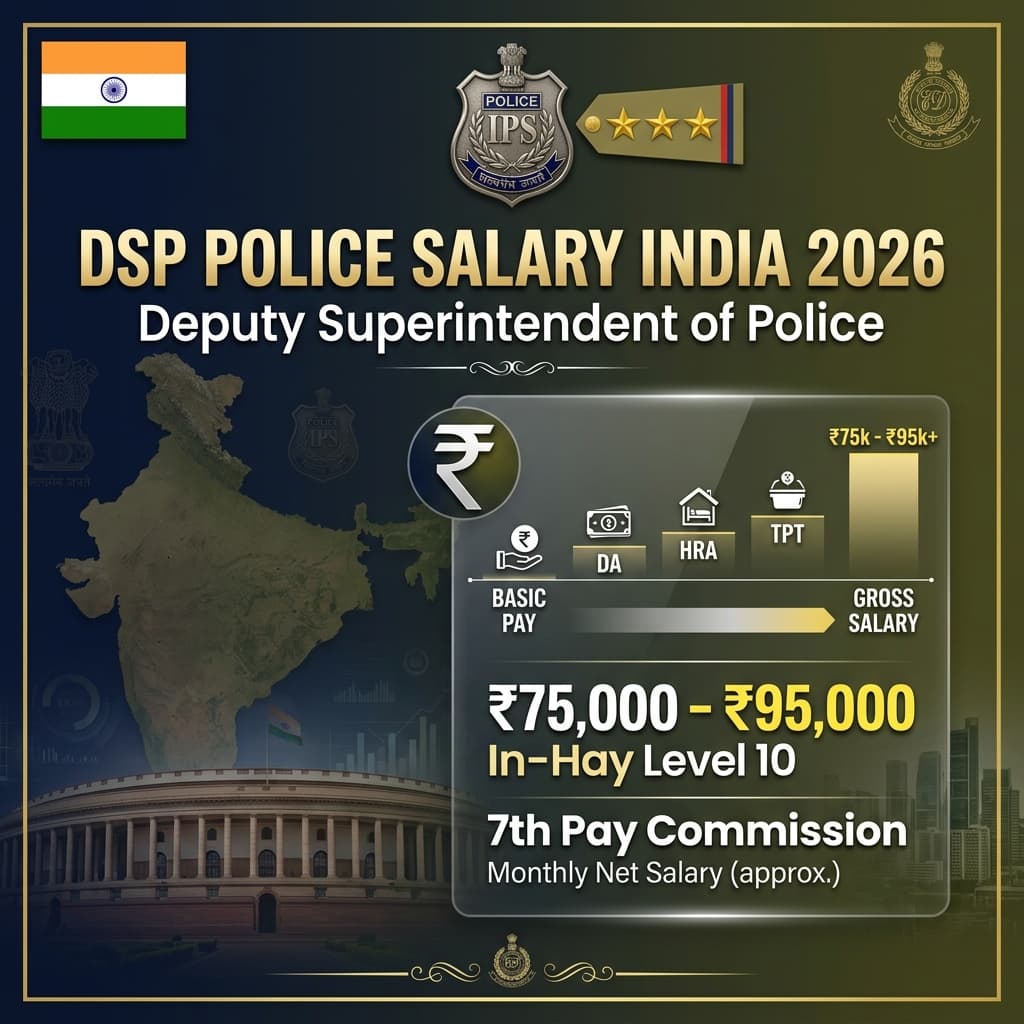
DSP Full Form and Salary
DSP stands for Deputy Superintendent of Police. It is one of the most coveted senior positions in the State Police Services. The salary of a DSP depends on the state police service, the assigned pay level (Level 10 under the 7th Pay Commission), basic pay, and location-specific allowances. Whether referred to as DSP or DySP, the rank is a Group-A Gazetted post that commands high respect and excellent compensation.
DSP Salary Per Month
A DSP's monthly salary is not a single fixed number; it is calculated based on several components. The general formula for calculating the monthly in-hand salary is:
Basic Pay + DA + HRA + TA + Allowances − Deductions = Approx. In-Hand Salary
DSP Pay Scale and Grade Pay
Understanding the DSP pay scale requires looking at the official pay grades. The entry-level Deputy Superintendent of Police pay level corresponds to Level 10 of the pay matrix. Older references may use Grade Pay (₹5,400), while current government pay structures generally use Pay Matrix Levels. Below is the structural framework of the entry-level pay parameters:
| Pay Parameter | Value |
|---|---|
| Pay Matrix Level | Level 10 |
| 6th CPC Grade Pay Equivalent | ₹5,400 |
| 6th CPC Pay Band | PB-3 (₹15,600 – ₹39,100) |
| Basic Pay (Minimum) | ₹56,100 / month |
| Basic Pay (Maximum) | ₹1,77,500 / month |
| Dearness Allowance (DA) – FY 2025-26 | 55% of Basic Pay |
| HRA – Class X Metro Cities | 30% of Basic Pay |
| HRA – Class Y Cities | 20% of Basic Pay |
| HRA – Class Z / Rural | 10% of Basic Pay |
| Transport Allowance (TA) – Metro | ₹7,200 + DA |
DySP Salary in India
Many candidates ask about the DySP salary compared to a DSP's salary. It is important to note that DSP and DySP (Deputy Superintendent of Police) are the exact same rank. Different states simply prefer different abbreviations. For instance, Maharashtra, Karnataka, and Kerala frequently use DySP, while Uttar Pradesh, Haryana, and West Bengal prefer DSP. The pay scale, duties, and uniform (three stars) are identical.
DSP In-Hand Salary Estimator (2026)
Configure your DSP pay cell and city to estimate take-home pay
DSP In-Hand Salary – Detailed Breakdown (2026)
The in-hand (take-home) salary of a DSP at the entry level (Pay Level 10, Cell 1, Basic Pay ₹56,100) in a Class Y city at 55% DA and without government quarter is approximately ₹79,000 – ₹82,000 per month. Here is a sample calculation:
| Salary Component | Monthly Amount (₹) |
|---|---|
| Basic Pay (Pay Level 10, Cell 1) | 56,100 |
| Dearness Allowance (55% of Basic) | 30,855 |
| HRA – Class Y City (20% of Basic) | 11,220 |
| Transport Allowance (₹3,600 + 55% DA) | 5,580 |
| Medical Allowance | 1,000 |
| GROSS SALARY | 1,04,755 |
| Less: NPS (10% of Basic) | -5,610 |
| Less: CGEIS Group Insurance | -1,500 |
| Less: Professional Tax | -200 |
| Less: Income Tax (Est.) | -0 (Below ₹12L rebate) |
| NET IN-HAND SALARY | ~₹97,445 |
DSP Allowances & Non-Monetary Perks
Beyond the base salary, DSPs are entitled to a wide range of benefits that significantly enhance the effective compensation package:
Government Accommodation
DSPs are entitled to government bungalows with attached staff (orderly) and maintenance paid by the state government. If not allotted, HRA is paid.
Official Vehicle & Driver
A government vehicle with a driver is provided for official duties. Some states also provide a fuel allowance for personal vehicles.
Security Personnel
Depending on jurisdiction and threat perception, DSPs may be assigned personal security staff or police orderlies.
Leave Travel Concession (LTC)
Central government-equivalent LTC rules apply. DSPs can avail domestic or All India LTC for themselves and family.
Uniform & Kit Allowance
Annual kit maintenance allowance and uniform stitching charges are provided for official dress maintenance.
Pension & Retirement Benefits
DSPs recruited before 2004 receive OPS pension. Those recruited after 2004 are under the National Pension System (NPS) with 14% employer contribution from state.
DSP Salary State-Wise Breakdown & Comparison
While the starting basic pay remains ₹56,100 across the vast majority of State Police Services, the net monthly take-home salary varies widely depending on state-specific Dearness Allowance (DA) and City House Rent Allowance (HRA) tiers. Here is a detailed look at the key states:
West Bengal, Odisha & Jharkhand
The starting DSP salary in West Bengal is highly competitive, fetching around ₹76,000 to ₹84,000 per month under ROPA rules. Similarly, the DSP salary in Odisha and Jharkhand ranges from ₹77,000 to ₹83,000.
Maharashtra & Karnataka (DySP)
The DySP salary in Maharashtra and Karnataka is heavily influenced by Class X cities like Mumbai, Pune, and Bengaluru. Due to higher HRA (30%), the starting salary can reach ₹80,000 to ₹95,000.
Telangana & Andhra Pradesh
The DSP salary in Telangana and AP starts with a slightly higher base of ₹58,850 in some scales. In cities like Hyderabad, the gross starting package yields up to ₹92,000.
UP, Haryana & Assam
For northern states, the DSP salary in UP and Haryana starts at standard Level 10 scales, yielding around ₹78,000 to ₹85,000. The DSP salary in Assam is also aligned with these scales, yielding approximately ₹75,000 to ₹82,000 in-hand.
Below is the comprehensive comparison table for entry-level DSP salaries across various states:
| State | Basic Pay | Approx. In-Hand | Notes |
|---|---|---|---|
| Uttar Pradesh (UP) | ₹56,100 | ₹78,000 – ₹85,000 | Class Y cities; state DA at 50% |
| Madhya Pradesh (MP) | ₹56,100 | ₹77,000 – ₹84,000 | State DA varies; Bhopal is Class Y |
| Bihar | ₹53,100 | ₹72,000 – ₹78,000 | Uses state-specific basic pay; Patna is Class Y |
| Rajasthan | ₹56,100 | ₹78,000 – ₹86,000 | Jaipur is Class Y; state DA at 53% |
| Telangana | ₹58,850 | ₹82,000 – ₹92,000 | Higher basic; Hyderabad is Class X city |
| Maharashtra | ₹56,100 | ₹80,000 – ₹95,000 | Mumbai/Pune are Class X; high HRA |
| Karnataka | ₹56,100 | ₹79,000 – ₹90,000 | Bengaluru is Class X; higher cost of living |
| West Bengal | ₹56,100 | ₹76,000 – ₹84,000 | Kolkata is Class X; state DA lower |
| Odisha | ₹56,100 | ₹77,000 – ₹83,000 | OPS (pre-2004) or NPS; Bhubaneswar Class Y |
| Chhattisgarh | ₹56,100 | ₹76,000 – ₹82,000 | State follows 7th CPC with minor variations |
DSP Career Path & Promotion Hierarchy
DSPs in the State Police Services follow a structured promotion hierarchy. Direct-recruit DSPs (via PCS) and promoted DSPs (from Inspector cadre) follow slightly different timelines:
DSP / Dy. SP
Entry-Level / Promotion from Inspector | Pay Level 10 (₹56,100 – ₹1,77,500)
Additional SP (Addl. SP)
After ~5–8 years as DSP (by seniority/selection) | Pay Level 11 (₹67,700 – ₹2,08,700)
Superintendent of Police (SP)
IPS empanelment or State Police Promotion | Pay Level 12 (₹78,800 – ₹2,09,200)
Senior SP / SSP
After 12–15 years of combined service | Pay Level 13 (₹1,23,100 – ₹2,15,900)
DIG / IGP
Senior cadre – IPS-level equivalence | Pay Level 14 (₹1,44,200 – ₹2,18,200)
How to Become a DSP in Police Force
For those wondering how to become a dsp in police or how to become dsp in police departments, there are two primary routes to entry. Direct recruits are promoted higher up to senior ranks where their payout scales into the sp salary bracket (Pay Level 12 basic of ₹78,800 to ₹2,09,200). Here are the two main pathways:
Route 1: Direct Recruitment via State PSC
- Appear in State Public Service Commission (PSC) Exam (e.g., UPPSC, MPPSC, BPSC)
- Minimum qualification: Graduate degree from any recognized university
- Age limit: Usually 21–40 years (with relaxations for reserved categories)
- Selection process: Prelims → Mains → Interview → Medical Test
- Training: 1–2 years at Police Training Academy
Route 2: Promotion from Inspector
- Police Sub-Inspectors are promoted to Inspector rank
- After 5–10 years of service as Inspector, eligible for DSP promotion
- Based on seniority, DPC (Departmental Promotion Committee) and ACR
- Departmental exam may be required in some states
- Both routes lead to the same Pay Level 10 grade
DSP vs IPS Officer – Key Differences
A common question is how a DSP differs from an IPS (Indian Police Service) officer. Both hold senior police positions, but there are significant differences in jurisdiction, authority, and career trajectory:
| Parameter | DSP (State Police Service) | IPS Officer (All India Service) |
|---|---|---|
| Recruitment | State PSC Exam / Promotion | UPSC Civil Services Exam |
| Pay Scale | Pay Level 10 (₹56,100–₹1,77,500) | Pay Level 10 onwards (same entry, faster progression) |
| Career Growth | Up to DIG/ADGP (state-level) | DGP, Director IB/CBI, Central Deputation |
| Jurisdiction | State only | Anywhere in India; all India service |
| Entry Rank | DSP (Group-A State Service) | ASP/SP (directly under IPS cadre) |
| Is DSP more powerful than IPS? | No | IPS has wider authority and faster promotions |
Frequently Asked Questions (FAQ)
What is the monthly salary of a DSP in India?
The starting monthly in-hand salary of a DSP is approximately ₹78,000 to ₹85,000. This is calculated from a basic pay of ₹56,100 (Pay Level 10) plus Dearness Allowance (DA), House Rent Allowance (HRA), and Transport Allowance, minus standard deductions like NPS and tax.
What is the Grade Pay of a DSP?
Under the old 6th Pay Commission, the Grade Pay for a DSP was ₹5,400. In the current 7th Pay Commission structure, this translates to Pay Matrix Level 10.
Is there any difference between DSP and DySP salary?
No. DSP and DySP are the same rank and hold the same Pay Level 10 scale. The salary is identical; only the abbreviation used varies by state.
What is DSP qualification (educational requirement)?
To become a DSP through direct recruitment, a candidate must hold a Bachelor's degree from a recognized university. Any stream is accepted. Additionally, candidates must meet the physical fitness standards set by the respective state PSC, which includes height, chest measurement, and vision requirements. For promotion from Inspector, service record and departmental exams are the key criteria.
What deductions are made from DSP salary?
Key deductions from DSP salary include: NPS contribution (10% of basic pay for post-2004 recruits), Central Government Employees Group Insurance Scheme (CGEIS) at approximately ₹1,500/month, Professional Tax (₹200/month in most states), and Income Tax (nil for most entry-level DSPs under the new regime if income is below ₹12 lakh).
Do DSPs get a government house and vehicle?
Yes. DSPs are entitled to government accommodation (type III or IV bungalow depending on availability) with utilities partially subsidized. They also receive an official vehicle with a driver for on-duty purposes. If government quarters are not available, HRA is paid at the applicable city class rate (20–30% of basic pay for urban postings).
What is the DSP salary in UP, MP, Bihar, and other states?
Most states follow the 7th CPC Pay Level 10 structure with a basic pay starting at ₹56,100. However, state-specific DA rates, HRA city classifications, and supplements vary: UP DSPs earn ₹78,000–₹85,000 in-hand; MP DSPs earn ₹77,000–₹84,000; Bihar DSPs may have a slightly different basic of ₹53,100 (state-specific); Telangana DSPs earn ₹82,000–₹92,000 due to higher basic and Hyderabad being Class X city.
What happens after DSP – next promotion?
After serving as DSP, officers are promoted to Additional Superintendent of Police (Addl. SP) at Pay Level 11 (₹67,700–₹2,08,700), and then to Superintendent of Police (SP) at Pay Level 12. Outstanding state service officers may be empanelled into the IPS cadre through a DPC process, which significantly expands their career options to national-level postings.
Conclusion
The Deputy Superintendent of Police (DSP) is a prestigious and powerful gazetted position in the Indian State Police Service. With a starting in-hand salary of ₹78,000–₹85,000 per month and access to government accommodation, official vehicle, and comprehensive NPS/pension benefits, the DSP role offers one of the best compensation packages in state government services. Use the DSP Salary Estimator above to calculate your exact expected take-home pay based on your specific state, city classification, and service seniority level.

Rohit Kushwaha
Software Engineer & Creator of mysalarycalculator.in
I'm Rohit Kushwaha, a Software Engineer with 3+ years of experience in developing web applications and digital solutions. By combining technology with practical financial tools, I built mysalarycalculator.in to help Indian professionals easily understand their salary, taxes, EPF, gratuity, and take-home income.
Comments & Discussion (0)
Join the Conversation
No comments yet. Be the first to start the discussion!