Profit Margin Calculator 2026: Gross, Operating & Net Margin
Calculate all three tiers of business profitability from a one-page income statement. Find your gross margin, EBIT margin, and net profit margin — with dynamic waterfall charts and markup vs margin analysis.
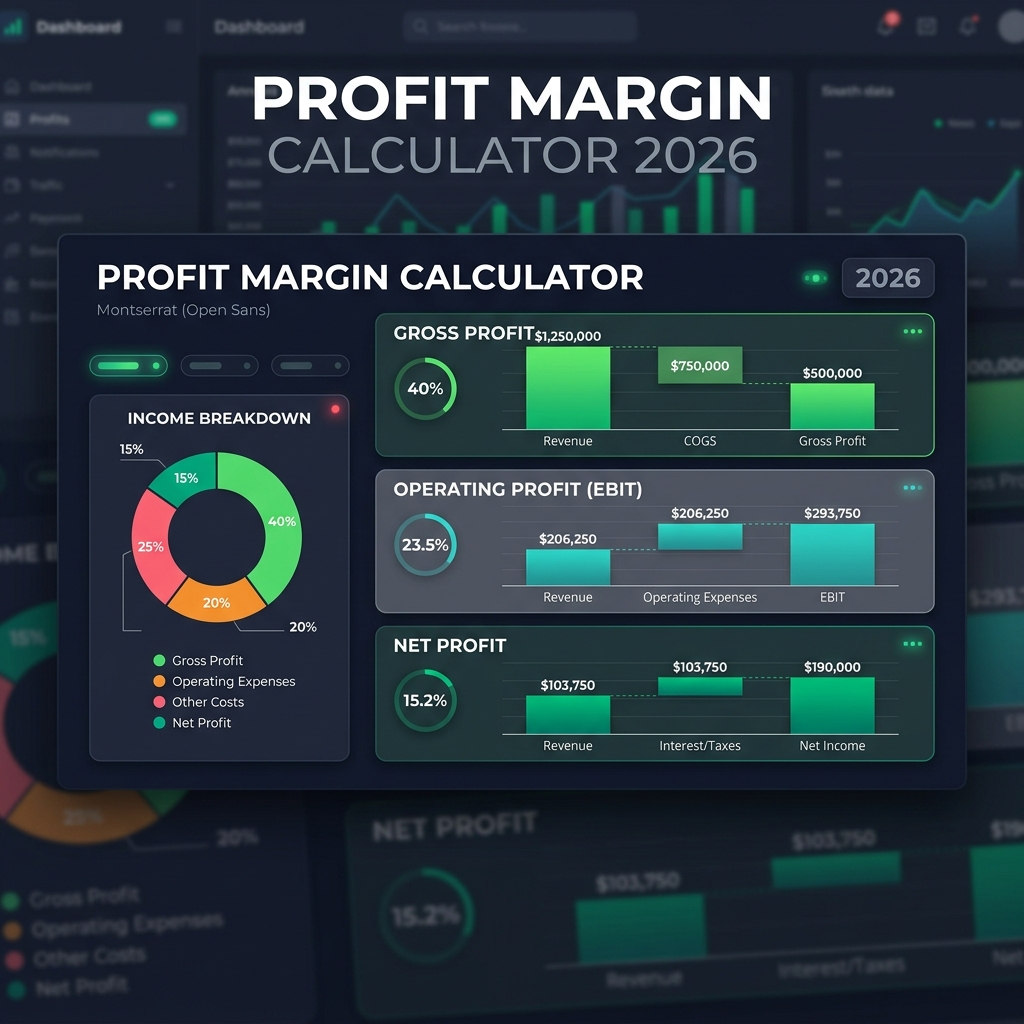
Gross Margin
Measures how efficiently your business produces goods. A higher gross margin means more runway for operating costs and profits.
Operating Margin (EBIT)
Reflects how well you control operating expenses like rent, salaries, and marketing after earning gross profit.
Net Profit Margin
The bottom-line metric — what percentage of revenue is actual take-home profit after all costs, interest, and taxes.
Profit Margin Analyzer
Income Statement Margin Modeler
Gross → Operating → Net Profit cascade
Complete Guide to Profit Margins for Indian Businesses
Whether you run a kirana store in Chennai, an e-commerce brand from Delhi, or a manufacturing plant in Pune, profit margins are the single most critical measure of your business health. Knowing how much of every rupee of sales you actually keep is the foundation of all pricing, investment, and growth decisions.
A Profit Margin Calculator 2026 removes the guesswork. By entering a few income statement figures, you instantly see your gross, operating, and net margins — the three-tier profitability framework used by chartered accountants, investment analysts, and bank loan officers across India.
1. Gross Profit Margin — The Production Efficiency Score
Gross profit margin measures how efficiently your business converts raw sales into profit after accounting only for the direct costs of producing or purchasing your products. These direct costs — called the Cost of Goods Sold (COGS) — include raw materials, manufacturing labor, and freight-in charges.
Gross Margin % = (Revenue – COGS) ÷ Revenue × 100
For example, if your e-commerce store earns ₹10,00,000 from sales and pays ₹6,00,000 to suppliers for the products, your gross profit is ₹4,00,000 — a 40% gross margin. This 40% is the margin available to pay for rent, salaries, advertising, and eventually profit. FMCG companies in India typically maintain 45–60% gross margins because of strong brand premium. E-commerce businesses often run at lower 30–45% gross margins because of heavy logistics costs.
2. Operating Profit Margin (EBIT) — Operational Control Score
Operating profit — also called EBIT (Earnings Before Interest and Tax) — is calculated by subtracting operating expenses from gross profit. Operating expenses include rent, employee salaries, electricity, advertising spend, software subscriptions, and other day-to-day overhead costs.
Operating Margin % = EBIT ÷ Revenue × 100
Continuing the example: ₹4,00,000 gross profit minus ₹1,50,000 operating expenses gives ₹2,50,000 EBIT — a 25% operating margin. This margin is widely considered the most powerful indicator of operational efficiency because it strips away the effect of financing decisions (loan interest) and tax strategies. Investors and lenders closely scrutinize EBIT margins when evaluating a company.
3. Net Profit Margin — The Bottom-Line Truth
Net profit margin is the ultimate measure of profitability. It reflects what you actually take home after paying every rupee of cost — including production costs, operating expenses, bank loan interest, and income tax. In India, the standard corporate income tax rate for domestic companies is 25% (for businesses opting the new tax regime under Section 115BAA).
Net Margin % = Net Profit (PAT) ÷ Revenue × 100
From our example: ₹2,50,000 EBIT minus ₹20,000 interest minus ₹57,500 tax (25% on ₹2,30,000 EBT) = ₹1,72,500 net profit, giving a net margin of 17.25%. This is an excellent margin for most Indian businesses. The average net margin across all listed NSE companies typically hovers between 7% and 12%.
4. Markup vs Margin — The Critical Distinction Most Sellers Miss
One of the most common and costly mistakes among small business owners, wholesalers, and FMCG distributors is confusing Markup with Margin. They sound similar but measure completely different things:
- Profit Margin is calculated as a percentage of the selling price (revenue):
(Profit / Selling Price) × 100. - Markup Percentage is calculated as a percentage of the cost price:
(Profit / Cost Price) × 100.
A product that costs ₹600 and sells for ₹1,000 has a profit of ₹400. The margin is 40% (₹400 / ₹1,000), but the markup is 66.7% (₹400 / ₹600). If a retailer says “I keep a 40% markup,” they actually retain a 28.6% margin. Our Quick Reverse Mode calculator handles this conversion automatically.
5. Proven Strategies to Improve Profit Margins
- Renegotiate supplier pricing: Even a 3–5% reduction in COGS directly raises gross margin without touching pricing.
- Raise prices on high-demand SKUs: Premium customers are often less price-sensitive. Test small price increases on bestsellers and analyze conversion drops carefully.
- Cut low-margin product lines: Eliminating SKUs with thin margins frees working capital for higher-return products.
- Optimize operating expenses: Audit monthly subscriptions, renegotiate office lease terms, and automate manual processing tasks to reduce overhead costs.
- Improve collection cycles: Reducing Days Sales Outstanding (DSO) lowers interest costs on working capital loans, which improves net margin.
Frequently Asked Questions (FAQs)
What is a good net profit margin for an Indian small business?
For most Indian SMEs and retail businesses, a net profit margin between 8% and 15% is considered healthy. IT and software companies often achieve 15–25%, while grocery and commodity trading businesses may operate on very thin 1–4% margins due to high competition and thin pricing flexibility.
Why is my gross margin high but net margin very low?
This usually indicates that your operating expenses — such as rent, employee salaries, advertising spend, or distribution costs — are consuming a disproportionate share of your gross profit. Review your overhead structure, particularly fixed costs like office space, and focus on automating repeatable tasks to reduce labor costs.
What is the difference between margin and markup in simple terms?
Margin is the profit expressed as a percentage of the selling price. Markup is the profit expressed as a percentage of the cost price. They always differ. A 50% markup on a ₹100 product (selling at ₹150) equals only a 33.3% profit margin. Always clarify which metric your business partners are using.
Does GST affect the profit margin calculation?
GST itself does not directly affect profit margins because it is a pass-through tax. You collect GST from customers and remit it to the government. However, if you sell to end consumers who cannot claim ITC, effective pricing must account for GST-embedded costs. Input tax credit can also reduce your effective COGS, improving gross margins.
What is the typical gross margin for FMCG businesses in India?
Large FMCG companies in India such as HUL, Nestle, and Dabur typically report gross margins between 45% and 60%. For small FMCG distributors and retailers, the margin is much lower, typically ranging from 5% to 15% depending on competition and regional pricing.
Can a business survive with a negative gross margin?
Technically yes, in the short term — especially for venture-funded startups that subsidize customer acquisition. However, a negative gross margin means the business loses money on every sale, requiring external funding indefinitely. Sustainable businesses must achieve positive gross margins to have any path to profitability.
How does interest expense affect the profit margin?
Interest on working capital loans, business term loans, and overdraft facilities is an expense that reduces EBT (Earnings Before Tax). High-interest borrowings, especially at Indian MSME lending rates of 12–18% p.a., can significantly compress net margins. Replacing expensive short-term debt with lower-cost long-term financing improves net margin.
How does the Quick Reverse Mode calculator help e-commerce sellers?
E-commerce sellers on platforms like Amazon, Flipkart, or Meesho often know their landed product cost and need to calculate a selling price that covers platform fees (usually 15–25%), shipping, GST, and still delivers a target margin. The Reverse Mode takes your target margin % and cost and instantly computes the required selling price.

Rohit Kushwaha
Software Engineer & Creator of mysalarycalculator.in
I’m Rohit Kushwaha, a Software Engineer with 3+ years of experience in developing web applications and digital solutions. By combining technology with practical financial tools, I built mysalarycalculator.in to help Indian professionals easily understand their salary, taxes, EPF, gratuity, and take-home income.
Ask a question or share your feedback