DUSU President Salary: Pay, Allowances, Powers, and Reality
1. Introduction to the DUSU Presidency
The **Delhi University Students’ Union (DUSU)** is widely recognized as the largest and most politically influential student union in India. Serving as the student government for the University of Delhi, it represents tens of thousands of undergraduate and postgraduate students across dozens of affiliated colleges. The role of the **DUSU President** is highly coveted, standing as the apex leadership position within Delhi’s campus politics.
Every year, student wings of national political parties, primarily the Akhil Bharatiya Vidyarthi Parishad (ABVP – aligned with BJP) and the National Students’ Union of India (NSUI – aligned with Congress), engage in intense, high-profile election campaigns. The DUSU election acts as a microcosm of India’s national political arena, with campaigns featuring rallies, pamphlets, high-profile media coverage, and endorsements from senior national politicians.
As student representative, the DUSU President serves as the direct link between the student body and the university administration, including the Vice-Chancellor. The position carries significant social prestige, influence, and the power to shape university policies, student amenities, and transport services.
2. The Compensation Reality: Do Student Union Leaders Get Paid?
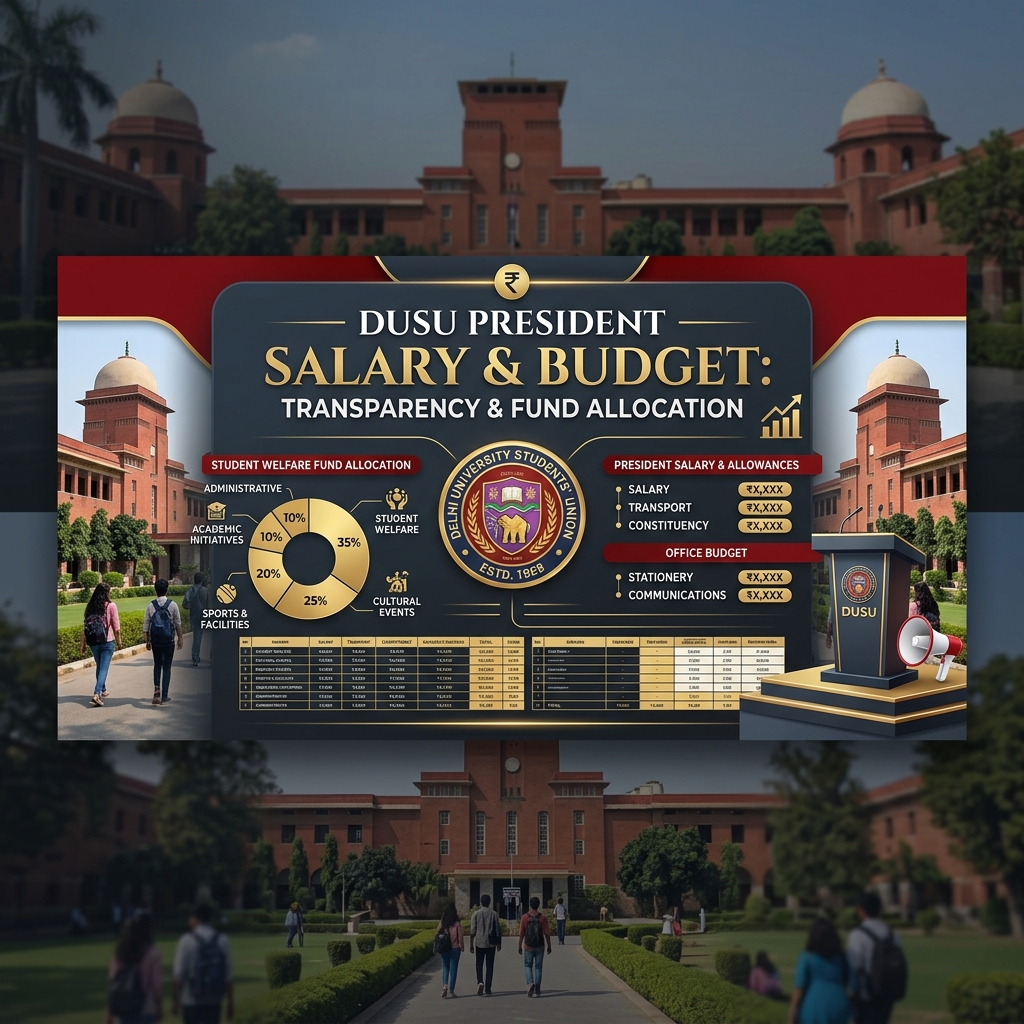
A common question among students and outsiders is: *How much salary does the DUSU President get?* The answer is simple and absolute: **There is no salary for the DUSU President.**
The position of the DUSU President is **completely honorary**. Neither Delhi University nor the University Grants Commission (UGC) provides any direct financial compensation, monthly salary, stipend, or attendance allowance to elected union officers. The constitution of DUSU defines these roles as volunteer representative positions dedicated to student service and campus advocacy.
Unlike elected public officials such as Members of Parliament (MPs) or Members of Legislative Assemblies (MLAs), student leaders do not have access to government payrolls. This lack of a direct salary is standard across most central and state universities in India, reinforcing the principle that student politics should be driven by student interest rather than monetary gain.
3. Official Budget Allocations: How the ₹20 Lakhs Fund is Managed
Although the DUSU President does not receive a personal salary, they oversee the management and allocation of the **DUSU Union Fund**.
Delhi University collects a student union fee from every student enrolled in DUSU-affiliated colleges. This fee pools into an annual DUSU budget that ranges between **₹20 Lakhs and ₹25 Lakhs** (Rs. 2,000,000 to Rs. 2,500,000). The budget is managed by the student union executive committee under the supervision of the university’s staff advisers and DUSU treasurer.
The union fund is earmarked exclusively for student welfare and college activities. The standard distribution of these funds includes:
- Campus Festivals & Cultural Events (35%): Funding university-wide student festivals, rock concerts, and debates.
- Student Welfare & Grievance cells (25%): Supporting financial aid requests, health support systems, and women’s safety cells.
- Sports & Infrastructure Improvement (15%): Organizing inter-college athletic tournaments, gym upkeep, and common room facilities.
- Academic Seminars & Research Grants (15%): Funding public lectures, student publications, and career counseling workshops.
- Administrative Expenses (10%): Covering printing, office supplies, and meeting overheads.
While the President has a major say in proposing where the funds are utilized, all expenditures must be approved by university audits to prevent fund misappropriation.
4. Perks and Privileges: Office, Transport, and Networking
While direct monetary salary is ₹0, the presidency comes with considerable **indirect perks and privileges** that carry substantial real-world value.
First, the DUSU President is provided with a **dedicated union office room** within the North Campus of Delhi University. This space serves as the administrative headquarters of the student union, complete with meeting desks, clerical staff, and internet amenities.
Second, union representatives receive **official travel and transit facilitation**. While the university does not buy luxury cars for candidates, student wings arrange for official sports utility vehicles (SUVs) and jeeps for campaign duties and university events. Fuel expenses and transit overheads are often supported through organization sponsorships or union allowances.
Third, the role provides access to **high-security clearances and networks**. In times of campus tension or public demonstrations, the President is provided security liaison and coordinate directly with local police forces. Crucially, the President gets direct access to union ministers, corporate leaders, and academic chancellors, building a professional network that would take ordinary graduates years to cultivate.
5. The Lyngdoh Committee Guidelines on Campaign Expenditure
In 2006, the Ministry of Human Resource Development implemented the **Lyngdoh Committee recommendations** to curb the influence of money and muscle power in student union elections. These guidelines were approved by the Supreme Court of India and are legally binding for Delhi University.
Key regulations under the Lyngdoh guidelines include:
- Expenditure Limit: The maximum permitted expenditure per candidate is strictly capped at **₹5,000**.
- Source of Audit: Candidates must submit certified, audited accounts of their election expenses within two weeks of declaration of results.
- Propaganda Restrictions: No candidate is allowed to use printed pamphlets, banners, or posters. Only handmade posters and eco-friendly materials are permitted.
- No Party Symbols: Candidates cannot officially display national political party symbols (like the hand or lotus) on campus walls.
Candidates who fail to comply with these limits risk disqualification, and the university administration regularly monitors student actions during the election weeks.
6. Campaign Budgets on Campus: Ground Reality vs. Rules
While the Lyngdoh guidelines mandate a strict ₹5,000 budget cap, mainstream media reports and student surveys reveal a starkly different ground reality. DUSU elections are famous for their immense scale, often matching local municipal corporation polls.
To work around the ₹5,000 limit, candidate groups utilize **party-level campaigns**. While the candidate’s personal spending stays within audited parameters, student wings and parent political organizations spend significant sums on roadshows, printed flyers distributed outside the immediate campus gates, student transport buses, and media advertisements.
Investigative reports frequently estimate that active DUSU presidential campaigns cost between **₹10 Lakhs and ₹50 Lakhs** per slate, including food services, student events, pamphlets, social media campaign teams, and transport. This discrepancy is a subject of constant debate in academic circles, with reformers calling for stricter enforcement of Lyngdoh rules.
7. Career Trajectory: DUSU as a National Political Launchpad
The lack of direct salary is compensated by the massive **career launchpad** that the presidency provides. Winning a DUSU election establishes a young leader as a proven national-level political prospect.
Many former DUSU Presidents and officers have gone on to become Cabinet Ministers, Chief Ministers, and senior party spokespersons in India. Some notable examples include:
- Arun Jaitley: Former DUSU President (1974), who went on to serve as the Finance Minister and Defense Minister of India.
- Vijay Goel: Former DUSU leader, who became a Union Minister of State in the Central Government.
- Ajay Maken: Former DUSU President (1985), who rose to become a Union Cabinet Minister for Housing and Urban Poverty Alleviation.
- Alka Lamba: Former DUSU President (1995), who transitioned into state assembly representative and national political speaker.
For ambitious young people, the DUSU presidency is the ultimate fast-track entry into national leadership, making the voluntary, unpaid service well worth the investment of time and energy.

Ask a question or share your feedback