Gratuity Calculator 2026 India – Know Your Exact Benefits Instantly
Calculate your estimated gratuity, tax exemption limits, and taxable gratuity amount. Supports government, PSU, and private-sector employees.
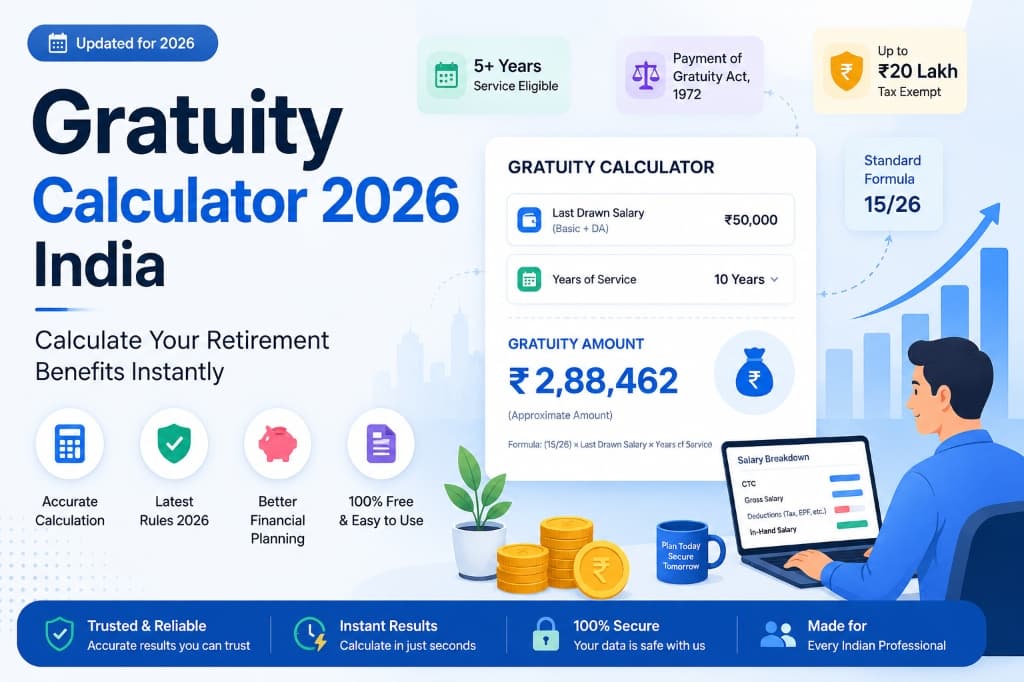
Gratuity Settings
Gratuity Eligible
You have completed 10 years and 0 months of continuous service. You meet the statutory 5-year service threshold under the Payment of Gratuity Act.
🧮 Calculation Breakdown
| Calculation Step / Item | Details | Result |
|---|---|---|
| Monthly Basic Pay | ₹50,000 | ₹50,000 |
| Monthly Dearness Allowance (DA) | +₹30,000 | ₹30,000 |
| Last Drawn Salary (Basic + DA) | Sum | ₹80,000 |
| Tenure for Calculation | 10 Yrs, 0 Mos (Rounded) | 10 Years |
| Formula Applied | 15 / 26 days wage method | 15/26 |
| Total Estimated Gratuity | (15 × 80000 × 10) ÷ 26 | ₹4,61,538 |
| Tax Exempt Portion | Exemption capped at ₹20,00,000 | -₹4,61,538 |
| Taxable Gratuity Amount | Gratuity - Tax-Free | ₹0 |
Gratuity Accumulation Trend
Taxability Share Breakup
What is Gratuity?
Gratuity is an important financial benefit provided by employers in India as a token of appreciation for long-term service. It acts as a lump-sum retirement or resignation benefit and is governed by the **Payment of Gratuity Act, 1972**. Employees usually become eligible after completing 5 years of continuous service, making it a key part of long-term financial planning.
It is a statutory benefit, meaning eligible employees cannot be denied gratuity by the employer. The payout is made when an employee leaves the organization after:
- Retirement or Superannuation
- Resignation after 5 years service
- Death (5-year rule is waived)
- Disablement due to accident/disease
Gratuity Calculation Formula
Covered Under the Gratuity Act
For employees whose organization employs 10 or more staff, calculations use the standard 26-day working month basis:
Rounding Rules:
Fractions of service of 6 months or more are rounded up to the next full year. For example, 7 years 6 months becomes 8 years.
Not Covered Under the Act
For organizations not registered or covered under the Act, the standard 30-day working month formula is generally applied:
Rounding Rules:
Only fully completed years of service are considered. Any remaining months or fractions of years are completely ignored.
What is "Last Drawn Salary"?
For the purpose of gratuity calculations, **Last Drawn Salary** is strictly defined as **Basic Pay + Dearness Allowance (DA)**. Other perks, bonuses, commissions, house rent allowance (HRA), or employer contributions to PF/NPS are excluded from the calculation.
Eligibility Criteria for Gratuity
To qualify for the payout of gratuity benefits at the time of leaving a job, an employee must satisfy these conditions:
5 Years Rule
Must complete at least 5 years of continuous service with the same employer.
Employee Count
The employer must have had 10 or more employees on any day of the preceding 12 months.
Exemption to 5-Year Rule
In cases of death or permanent disablement, the 5-year continuous service rule is waived.
Tax Rules and Exemption Limits on Gratuity
Gratuity payments enjoy tax benefits under **Section 10(10)** of the Income Tax Act, depending on the category of employee:
Government & PSU Employees
Any gratuity received by central government, state government, local authorities, or defence personnel is **100% tax-free** without any upper ceiling limits.
Private Sector Employees
For private-sector employees (covered under the Act), the tax exemption limit is calculated as the lowest of:
- Actual gratuity amount received.
- The statutory tax-free ceiling of **₹20 Lakhs** (raised from ₹10 Lakhs in 2018).
- Eligible gratuity calculated via the standard formula.
Frequently Asked Questions (FAQs)
Q.Is Dearness Allowance (DA) included in gratuity calculation?
Yes. In India, the salary for gratuity is defined as Basic Salary + Dearness Allowance (DA). All other allowances and bonuses are excluded.
Q.What happens to gratuity if the employee dies before 5 years?
In the case of death or permanent disability of an employee, the 5-year continuous service condition is waived, and the gratuity is paid fully to the employee or their nominee.
Q.Is there a maximum limit on tax-free gratuity in India?
Yes, for private employees, the maximum tax-free gratuity limit is ₹20 Lakhs. For government employees, gratuity is entirely tax-exempt.
Q.Can an employer refuse to pay gratuity?
No. If the organization is covered under the Payment of Gratuity Act and the employee meets the eligibility criteria, the payment of gratuity is a statutory obligation, and the employer cannot refuse it.
Q.How are months rounded in gratuity calculation?
For employees covered under the Act, if the fractional service in the last year is 6 months or more, it is rounded up to 1 year. If it is 5 months or less, the fraction is ignored.

Rohit Kushwaha
Software Engineer & Creator of mysalarycalculator.in
I'm Rohit Kushwaha, a Software Engineer with 3+ years of experience in developing web applications and digital solutions. By combining technology with practical financial tools, I built mysalarycalculator.in to help Indian professionals easily understand their salary, taxes, EPF, gratuity, and take-home income.
Comments & Discussion (0)
Join the Conversation
No comments yet. Be the first to start the discussion!