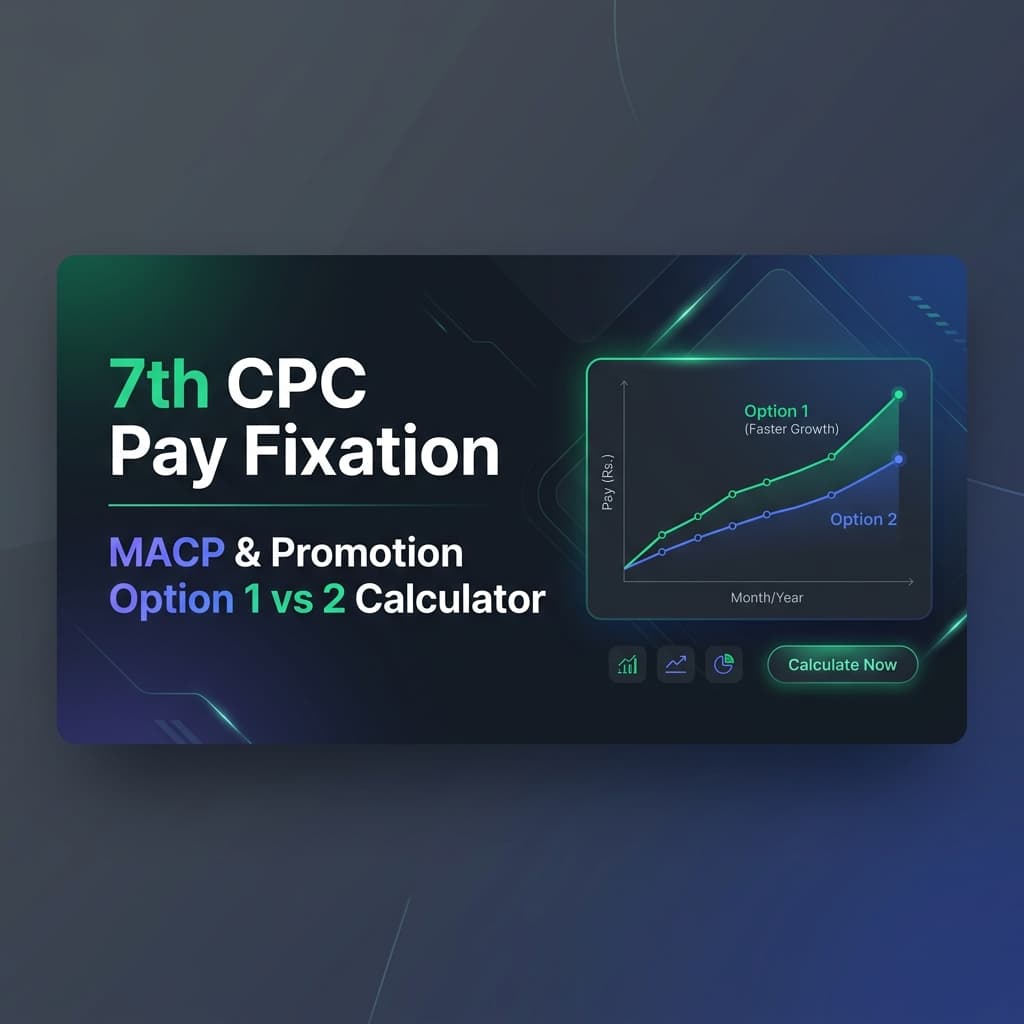
Pay Fixation Calculator (MACP & Promotion)
Compare 7th Central Pay Commission fixation options. Estimate your monthly basic salary progression and net takings to find the optimal fixation date (Date of Promotion vs DNI in lower post).

Fixation Settings
Number of months between the date of promotion/upgradation and your normal increment date (usually 1st January or 1st July).
Pay Fixation on Promotion and MACP (7th CPC): Complete Guide
An expert guide on Fundamental Rule (FR) 22(I)(a)(1), Rule 13 of CCS (RP) Rules 2016, Option 1 vs Option 2 rules, and DNI submission timelines.
1. Introduction to Pay Fixation on Promotion & MACP
When a Central Government employee receives a **Regular Promotion** or a financial upgradation under the **Modified Assured Career Progression (MACP)** scheme, their basic pay must be re-fixed in the higher pay level. Under the **7th Central Pay Commission (CPC)**, this pay fixation process is governed by the provisions of **Fundamental Rule (FR) 22(I)(a)(1)** read with **Rule 13 of the CCS (Revised Pay) Rules, 2016**.
The primary purpose of pay fixation is to guarantee the promoted employee a salary raise. This is achieved by first adding a **notional increment (equal to 3% of their current basic pay or moving down one cell step in the lower level)** to their current basic pay. The resulting target amount is then used to find a matching cell in the promoted level. The employee is placed at the cell value equal to or next higher than the target pay.
However, the date on which this re-fixation is officially calculated can significantly impact the employee's monthly salary and lifetime pension. Government rules offer employees an Option to choose this date.
2. What are the Two Options for Pay Fixation?
Under office memorandum rules, an employee has the choice between two strategies for re-fixing their pay scale upon promotion or MACP upgradation:
Option 1: Pay Fixation from the Date of Promotion / Upgradation
Under this option, the employee's pay is fixed immediately in the higher level on the very date they assume charge of the promoted post.
- **Procedure**: One notional increment (3%) is added to the basic pay in the lower level, and the pay is fixed at the equal or next higher cell in the promoted level.
- **Increment Cycle**: The next annual increment in the promoted level is granted after the employee completes **six months of qualifying service** in that level. This means if promotion occurs in March, the next increment falls in January of the next year.
Option 2: Pay Fixation from the Date of Next Increment (DNI) in the Lower scale
Under this option, pay fixation is deferred until the employee receives their regular annual increment in the lower scale.
- **Interim Period (Promotion Date to DNI)**: The employee's pay is fixed provisionally in the promoted level at the cell next higher to their pre-promotion basic pay (without the 3% notional increment).
- **On DNI Date**: Two steps occur: (1) The employee is granted their normal annual increment (3%) in the lower level. (2) The promotional fixation is then applied to this incremented basic pay by adding another notional increment (3%) and fitting the result into the promoted level matrix.
- **Increment Cycle**: The next annual increment in the promoted level will fall 6 months after the DNI date.
3. MACP vs Regular Promotion Pay Fixation Rules
Although the calculations under FR 22(I)(a)(1) are identical, there are operational differences between a Regular Promotion and MACP:
- Regular Promotion: Involves a change in designation, duties, and responsibilities. It may also lead to a change in the headquarters city, thereby modifying HRA and Travel Allowance eligibility.
- MACP (Modified Assured Career Progression): This is a financial upgradation scheme granted to employees upon completing 10, 20, and 30 years of continuous service in the same grade pay, provided they have received no regular promotions during those intervals. Under MACP, the employee only transitions to the next higher pay level in the matrix, but their duties, designation, and location allowances remain unchanged.
4. Example Calculation: Level 6 to Level 7 Fixation
Let's evaluate a practical case study. Consider an employee in Level 6 with a basic pay of **₹47,600** (Cell 11 of Level 6). They are promoted to Level 7 (ASO/Section Officer scale) with 4 months remaining until their next annual increment in Level 6 (DNI).
Under Option 1 (Immediate Fixation):
- Current Level 6 Basic: ₹47,600
- Add notional increment (+3%): Move to next cell in Level 6 = ₹49,000 (cell 12).
- Fix in Level 7: Find cell equal or next higher than ₹49,000. Level 7 cells are [44900, 46200, 47600, 49000, 50500...]. Since ₹49,000 exists, pay is fixed at **₹49,000** in Level 7.
- Annual Increment: Since DNI is in 4 months (<6 months), the increment is deferred. Employee stays at ₹49,000 for 10 months.
Under Option 2 (Fixation on DNI):
- Interim Period (4 Months): Pay is fixed provisionally at next higher cell in Level 7 relative to current basic (₹47,600). Next higher cell in Level 7 is **₹49,000**. Employee receives ₹49,000/mo.
- On DNI: (a) Grant normal increment in Level 6 (moves from ₹47,600 to ₹49,000). (b) Add promotional notional increment (moves from ₹49,000 to ₹50,500). (c) Fit ₹50,500 in Level 7. Next higher cell in Level 7 is **₹50,500**.
- Re-fixed Basic: Pay becomes **₹50,500** on DNI.
Comparing both, Option 2 is superior because after 4 months, the basic pay increases to **₹50,500**, whereas under Option 1 it remains at **₹49,000** until a deferred increment occurs. Choose Option 2 in this scenario.
5. Submission of Option Form Timeline
It is critical to note that the choice of fixation date is not automatic. According to DoPT rules, an employee must submit a written **Option Form** to their Head of Office (HOO) or Drawing and Disbursing Officer (DDO) within **one month** from the date of the promotion or MACP order. If the option form is not submitted within this one-month timeline, pay is fixed immediately under Option 1 by default, which can lead to a financial loss.
Frequently Asked Questions (FAQ) — Pay Fixation

Rohit Kushwaha
Software Engineer & Creator of mysalarycalculator.in
I'm Rohit Kushwaha, a Software Engineer with 3+ years of experience in developing web applications and digital solutions. By combining technology with practical financial tools, I built mysalarycalculator.in to help Indian professionals easily understand their salary, taxes, EPF, gratuity, and take-home income.
Comments & Discussion (0)
Join the Conversation
No comments yet. Be the first to start the discussion!