Loan Prepayment Calculator 2026: Save Interest & Reduce Tenure
Model your lump sum or recurring loan prepayments. Calculate total interest saved, evaluate tenure reduction, and compare balance trajectories with dynamic visualizations.
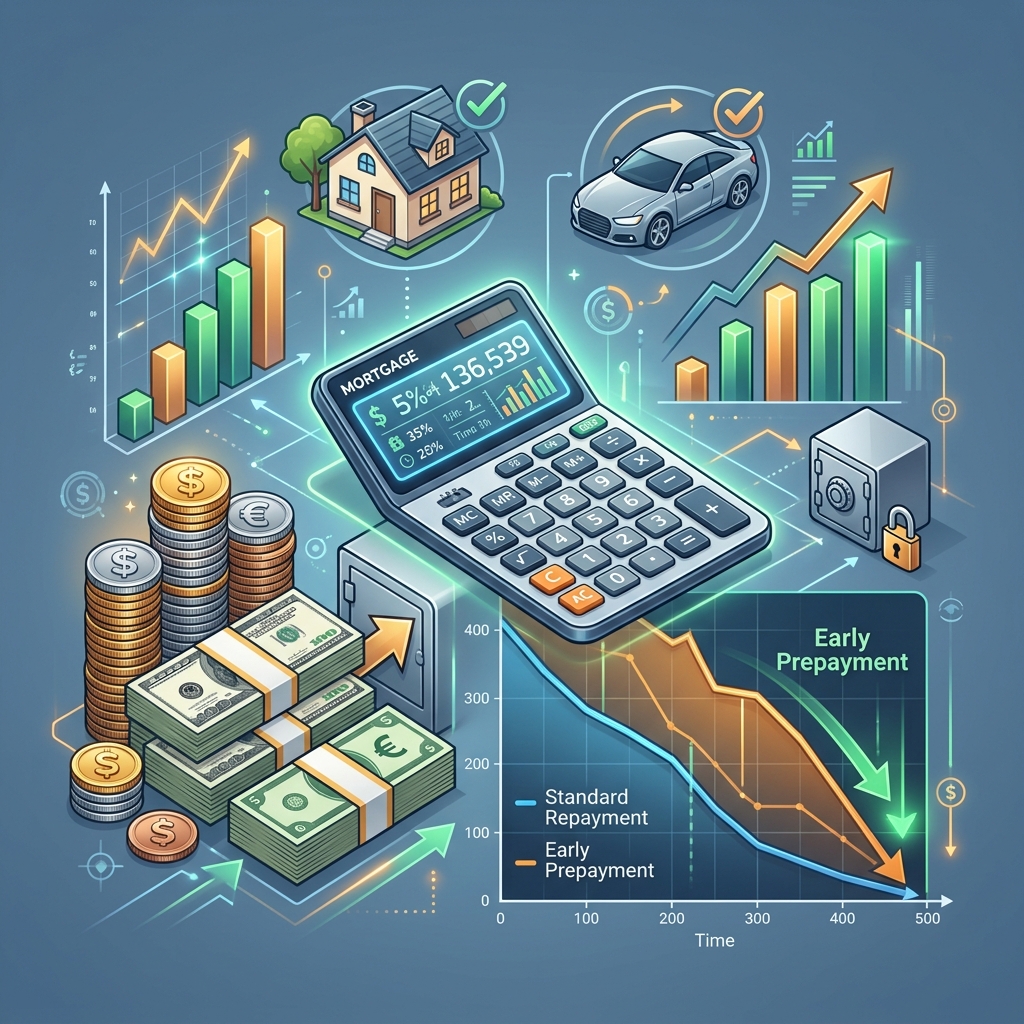
Direct Principal Reduction
Every extra payment directly clears your outstanding balance, skipping interest computations entirely.
Compounding Savings
Repaying principal early saves future interest compounding. Early prepayments yield maximum savings.
Tenure Reduction
Shortening tenure rather than lowering the EMI keeps monthly outgo unchanged but minimizes interest cost.
Loan Prepayment Simulator
Prepayment Math Modeler
Reducing Interest Schedule Comparisons
Base Loan Details
Prepayment Parameters
Loan Prepayment Calculator: A Master Guide
Taking a loan—whether it is a home loan to buy property, a personal loan for urgent cash needs, or a car loan—is a common method to achieve key life milestones. However, debt always comes at a price. Over a typical loan cycle, the cumulative interest you pay to a lender can represent a massive portion of the borrowed capital. In the case of long-term debts like home loans, the interest paid can easily exceed the principal borrowed.
Making a loan prepayment (paying off a chunk of your principal ahead of the EMI schedule) is one of the most effective ways to break free from this debt burden. By directly reducing the outstanding principal balance, prepayments stop the bank from compounding interest on that amount. Our online Loan Prepayment Calculator 2026 is designed to help you model different prepayment strategies—whether it is a one-time lump sum or recurring top-ups—and visualize exactly how much interest you can save and how many years you can shave off your loan.
1. What is Loan Prepayment and How Does It Work?
Under standard amortisation schedules, your monthly Equated Monthly Installment (EMI) is split into two components: interest charges and principal repayment. In the early stages of a loan, because the outstanding balance is high, the interest portion consumes the majority of your EMI payment.
A **prepayment** is any payment made in addition to your standard EMI. Unlike EMIs, prepayments do not cover interest charges; they are applied 100% directly to the outstanding principal balance. This instantly drops your outstanding balance, which means that in all future months, the interest (calculated as a percentage of the outstanding principal) drops as well, creating a cascading savings effect.
2. The Mathematical Logic: Why Early Prepayments Save More
Interest calculations are based on the reducing balance method. The interest charged in any month $m$ is:
Interest Paid = Balance × (Annual Interest Rate / 12 / 100)
Because of this monthly calculations model, making a prepayment early in the tenure yields significantly higher savings than making a prepayment later. Early in the loan, there are more remaining months for the reduced principal to compound interest savings.
Let us look at a worked example: You have an outstanding loan of ₹20,00,000 at 8.5% interest rate for a remaining tenure of 15 years (180 months).
- Scenario A (Standard): Your monthly EMI is ₹19,695. Over 15 years, your total interest paid is ₹15,45,066, and total outgo is ₹35,45,066.
- Scenario B (Prepayment): You make a one-time prepayment of **₹2,00,000** at month 12.
The outstanding balance drops by ₹2,00,000 instantly. The loan tenure is shortened by **25 months** (more than 2 years!).
The total interest paid drops to ₹12,71,992, saving you **₹2,73,074** in interest outgo.
3. Comparing Prepayment Types: Lump Sum vs. Recurring Top-Ups
Our calculator is highly flexible, enabling you to model and compare different prepaying styles:
- One-time Lump Sum Prepayment: Ideal when you receive a sudden influx of capital, such as an annual performance bonus, maturity of insurance policies, or sale of ancestral property.
- Monthly Extra top-up: Adding a fixed amount (e.g. ₹2,000 or ₹5,000) directly to your monthly EMI. This acts as a slow, steady reduction of principal, which is highly manageable for salaried individuals.
- Yearly Extra Payment: Making an extra payment equivalent to one or two EMIs once a year. Doing this simple top-up yearly can reduce a 30-year home loan by 5 to 7 years.
4. RBI Rules and Bank Charges on Loan Prepayments in 2026
The rules governing prepayments vary based on the loan category and type of interest rate:
| Loan Type | Floating Rate Charges | Fixed Rate Charges |
|---|---|---|
| Home Loans | Zero charges (RBI mandate) | 2% to 4% of prepaid amount |
| Personal Loans | Varies (usually 2% to 5%) | 3% to 6% of outstanding balance |
| Car Loans | Varies (usually 2% to 4%) | 2% to 5% of prepaid amount |
Important: Under current RBI rules, commercial lenders cannot charge prepayment penalties on floating-rate loans taken by individual borrowers. However, fixed-rate loans and corporate borrowers are still subject to bank penalty fees.
5. The Dilemma: Prepaying Loan vs. Investing
When deciding whether to use surplus savings to prepay a loan or invest, consider the **opportunity cost**. If your home loan interest rate is 8.5% p.a., prepaying it guarantees a tax-free risk-free return of 8.5%.
If you can invest that surplus money in equity mutual funds generating an expected 12% to 15% CAGR over the long term, investing might yield higher net wealth. However, investments are subject to market risks, whereas debt reduction is guaranteed. Balancing both options—paying off high-cost debt (like credit card loans at 36% or personal loans at 12%) first while maintaining an active SIP—is usually the wisest path.
Frequently Asked Questions (FAQs)
Is it better to reduce the monthly EMI or the loan tenure when prepaying?
It is mathematically better to reduce the loan tenure. By keeping your monthly EMI amount unchanged, you continue to pay off the principal at an accelerated pace, which results in much higher interest savings. Lowering the EMI reduces the monthly cash flow burden but yields lower interest savings.
Are there any restrictions on the minimum prepayment amount?
Yes, most banks enforce guidelines. Generally, lenders require a prepayment to be equivalent to at least 1 or 2 months of EMIs. Some banks also restrict prepayments to a specific number of times per financial year (e.g. up to 4 times a year).
Does making a loan prepayment improve my CIBIL credit score?
Yes. Prepaying a portion of your outstanding loan reduces your total outstanding debt burden and lowers your credit utilization. This exhibits excellent credit behavior to credit bureaus, which gradually increases your CIBIL score.
What is the ideal time in the loan lifecycle to make prepayments?
The best time to make prepayments is during the initial years of the loan. Since interest forms the bulk of your EMI payments early in the tenure, any principal reduction made during the first few years maximizes the compounding interest savings effect.
How do bank overdraft home loans (like SBI Maxgain) differ from standard prepayments?
In a standard prepayment, the money is permanently paid to the bank and cannot be retrieved. In an overdraft scheme (like SBI Maxgain), surplus savings are parked in a linked savings account. Interest is calculated on the net outstanding balance (Loan Outstanding – Savings balance), but you retain the freedom to withdraw the surplus funds whenever you need them.
Does the bank automatically reduce the tenure after I make a prepayment?
Yes. By default, banks apply prepayments toward reducing the remaining loan tenure while keeping your monthly EMI constant. If you want to keep the tenure same and reduce your monthly EMI instead, you must submit a formal request to your bank.
Can self-employed individuals claim prepayment costs as business expenses?
Yes, if the loan was taken specifically for business operations (e.g., a business expansion loan). Any interest paid and prepayment charges levied by the lender can be claimed as business expenses to reduce taxable business income under Section 37 of the Income Tax Act.
What are the prepayment rules for fixed-rate vs. floating-rate loans?
Under RBI guidelines, floating-rate loans taken by individual borrowers have zero prepayment or foreclosure penalties. However, fixed-rate loans (including personal loans, car loans, and some fixed home loans) are subject to prepayment penalties ranging from 2% to 6% of the prepaid or outstanding amount.

Rohit Kushwaha
Software Engineer & Creator of mysalarycalculator.in
I’m Rohit Kushwaha, a Software Engineer with 3+ years of experience in developing web applications and digital solutions. By combining technology with practical financial tools, I built mysalarycalculator.in to help Indian professionals easily understand their salary, taxes, EPF, gratuity, and take-home income.
Ask a question or share your feedback