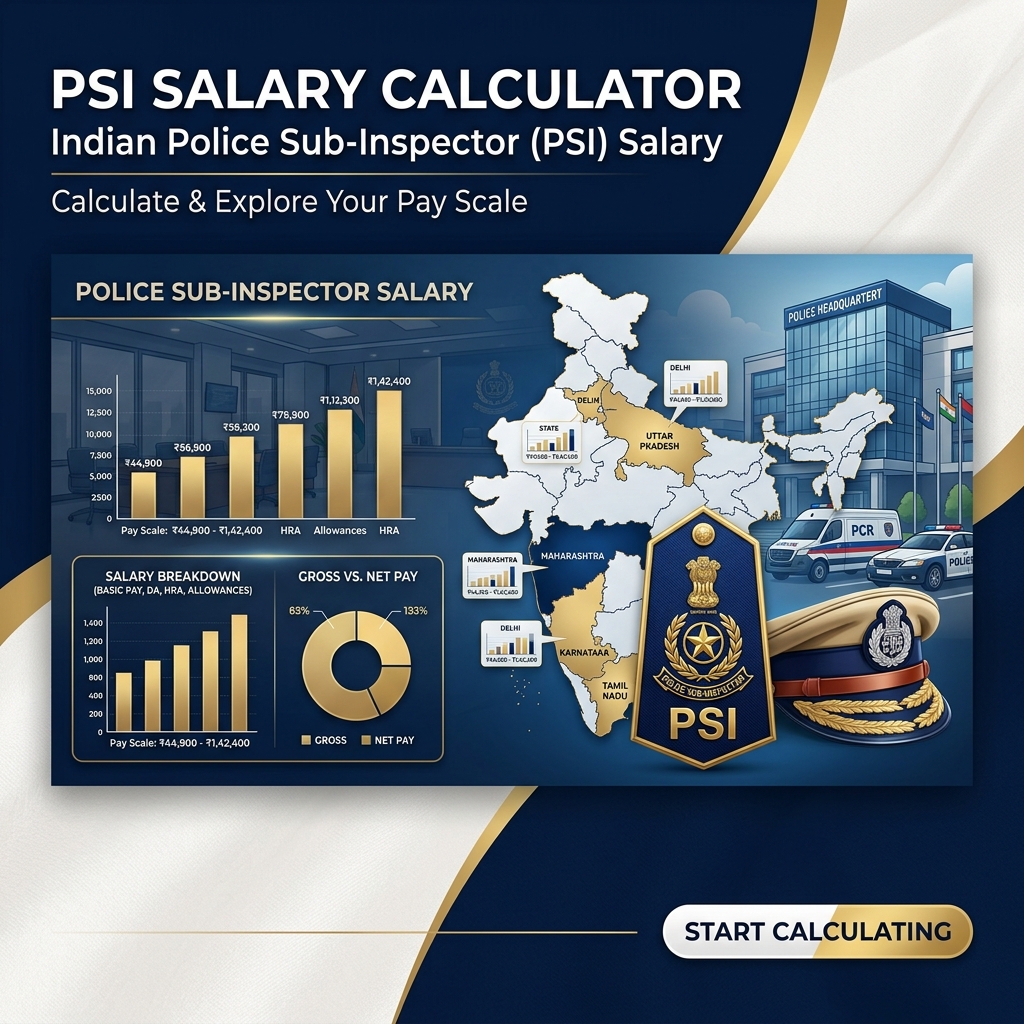
Police Sub-Inspector (PSI) Salary Guide: Slabs, Allowances & State Ranks
1. Introduction to Police Sub-Inspector (PSI) Ranks in India
The **Police Sub-Inspector (PSI)** is a crucial entry rank in the state law enforcement apparatus of India. Positioned above an Assistant Sub-Inspector (ASI) and below a Police Inspector, the PSI is usually the lowest-ranking officer who, under Indian police regulations, can file a charge sheet in court, and is usually the first investigating officer.
Recruitment to the rank of Police Sub-Inspector is conducted through two primary routes: direct entry via State Public Service Commissions (such as MPSC in Maharashtra, KPSC in Karnataka, and GPSC in Gujarat) or CAPF competitive exams conducted by UPSC/SSC (for Delhi Police), and departmental promotions from head constables and ASIs. PSIs command respect, carry executive powers, and receive stable salary packages structured around the **7th Pay Commission** guidelines.
2. State-wise PSI Pay Scales and Salary Matrix
Although most states follow the broad structure of the 7th CPC, the exact pay levels, probation rules, and state-specific grade pays vary considerably:
- Delhi Police (CAPF/Central Government): Operated under the Central Government, Delhi Police SIs are placed in **Pay Level 6** with a starting basic pay of **₹35,400**. With high central DA rates (60%) and X-city 30% HRA in Delhi, their gross monthly pay exceeds **₹65,000**.
- Karnataka Police: Karnataka PSIs fall under State Pay Level 7, with a basic scale of **₹37,900 to ₹70,850**. Their initial gross monthly salary, including city allowances and uniform grants, stands at approximately **₹58,000**.
- Maharashtra Police: Placed in S-14 grade with a basic pay scale of **₹38,600 to ₹1,22,800**. A Maharashtra PSI starts with a monthly gross of **₹52,000 to ₹60,000** depending on the city of posting.
- Gujarat Police: Gujarat operates a **fixed pay probation system** for the first five years. A Gujarat PSI on probation receives a flat monthly pay of **₹31,340** with no extra allowances. Post probation, they are placed in the regular Level 6 scale starting at **₹35,400** basic.
- Madhya Pradesh (MP) Police: MP Police Sub-Inspectors receive a basic pay of **₹36,200** with a grade pay of ₹3600 under state scales, yielding starting gross salaries of **₹48,000 to ₹55,000**.
- Uttar Pradesh (UP) & Bihar Police: Both states align with Central Level 6, starting at **₹35,400 basic**, with starting gross monthly salaries ranging between **₹52,000 and ₹62,000**.
- West Bengal Police: WBP Sub-Inspectors are placed in Level 10 of the state ROPA matrix, with a basic starting pay of **₹32,100**, leading to starting gross checks of **₹40,000 to ₹46,000**.
3. Allowances Breakdown: DA, HRA, Risk and Ration Allowances
A PSI’s gross pay scale is enhanced by allowances designed to support their duty in diverse field postings:
- Dearness Allowance (DA): Calculated as a percentage of basic pay to offset rising living costs. While central forces and most states align with **50% to 60% DA**, individual state cabinets approve separate rates.
- House Rent Allowance (HRA): SIs who are not provided government family quarters draw HRA. This is classified by city tiers: X-class cities (30% of basic), Y-class (20%), and Z-class rural police circles (10%).
- Risk / Hardship Allowance: Personnel posted to special operational tasks, anti-terrorist squads, or naxalite-affected regions (like Bastar in MP/Chhattisgarh or special units in Bihar) receive risk allowances of **₹6,000 to ₹9,700 per month**.
- Ration / Diet Money Allowance: Paid to non-gazetted officers to cover diet and nutrition costs during field operations, typically ranging from **₹2,000 to ₹3,500 per month**.
- Uniform & Kit Maintenance: A flat allowance (usually ₹1,000 to ₹1,500 per month or as an annual lump sum) is provided to maintain the police uniform and badges.
4. Mandatory Deductions on a PSI Salary Slip
From a PSI’s gross earnings, several deductions are made by the treasury before the final in-hand salary is credited:
- National Pension System (NPS) / GPF: Most states enforce a mandatory **10% basic salary + DA** deduction towards the employee’s retirement corpus under the NPS.
- Professional Tax (PT): A small state tax, typically a flat **₹200 per month**, is deducted.
- Group Insurance Scheme (GIS): A nominal monthly deduction of **₹50 to ₹100** to fund welfare insurance.
- Income Tax (TDS): Since SIs earn between ₹5.5 Lakhs and ₹8 Lakhs annually, they fall under tax slabs, resulting in monthly tax deductions of ₹2,000 to ₹5,000 depending on savings declarations.
5. Career Progression, Promotions, and 8th Pay Commission
Every PSI receives a mandatory **3% annual basic increment** on July 1st or January 1st of every year. In terms of promotion:
A Police Sub-Inspector starts as the chief investigating officer at a police station. After 7 to 10 years of service, depending on seniority list clearances and clearing departmental examinations, a PSI is promoted to **Police Inspector (PI)** (Level 7/8). Subsequent promotions lead to **Assistant Commissioner of Police (ACP) / Deputy Superintendent of Police (DSP)** (Level 10), and eventually **Additional Superintendent of Police (Addl. SP)**.
Furthermore, with initial discussions on the **8th Pay Commission** starting, state government employees expect a fitment multiplier (likely 2.57x or 2.62x) which would push the minimum basic scale of a PSI from ₹35,400 to approximately **₹91,000 per month**, significantly increasing in-hand checks and retirement pensions.

Ask a question or share your feedback