Next Increment Date Calculator & DNI Rules (2026)
Find your exact 7th CPC Date of Next Increment (DNI) based on your promotion or appointment date, calculate 3% annual matrix cell jumps, and analyze non-qualifying service delays.
What is the Date of Next Increment?
The Date of Next Increment (DNI) in the 7th Pay Commission is given on either 1st January or 1st July, depending on your date of appointment or promotion. An employee must complete at least 6 months (180 days) of qualifying service to receive the standard 3% annual increment, which moves them to the next higher cell in the Pay Matrix.
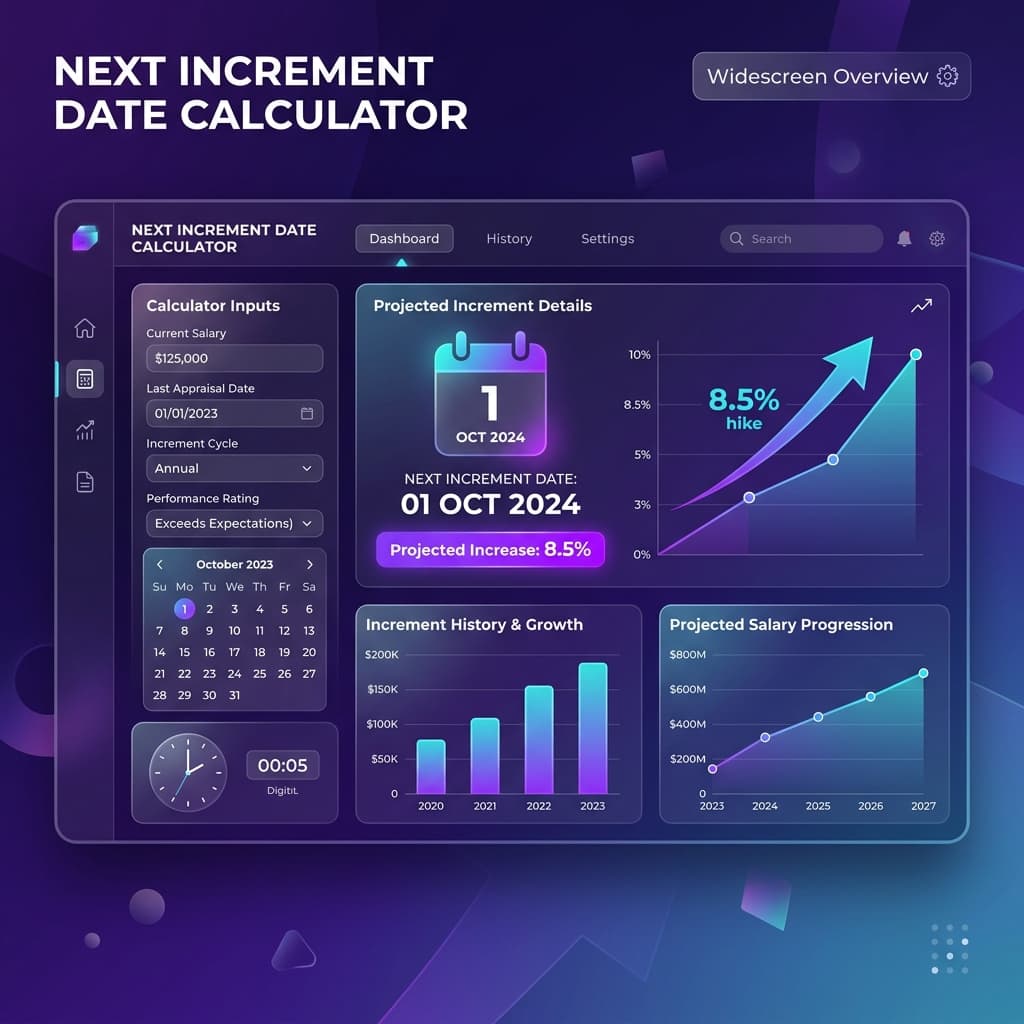
Parameter Inputs
The date of the last event determining your next increment.
Days of Extraordinary Leave (EOL) without medical certificate, suspends, or dies-non.
Pay Matrix Calculation Details
| Salary Parameter | Value (7th CPC) | Projected (8th CPC) | Slab Criteria Details |
|---|---|---|---|
| Current Basic Pay | ₹35,400 | ₹90,978 | Base pay grade level 6 |
| Annual Increment Amount (3%) | ₹1,100 | ₹2,827 | Approx 3% basic pay |
| Revised Basic Pay (Accrued DNI) | ₹36,500 | ₹93,805 | Rounded to higher cell in matrix |
| Next Increment Date (DNI) | 1 January 2027 | Subject to qualifying service | |
Pay Scale Growth
5-Year Compound Basic Projection
Central Government Annual Increment Regulations (7th CPC)
Annual increments serve as the standardized mechanism for rewarding continuous service and offseting living cost increases for central government personnel in India. Under the **7th Central Pay Commission (7th CPC)** pay matrix guidelines, the traditional grade pays and incremental pay bands have been integrated into a comprehensive and unified **Pay Matrix**.
Rule 10 of the Central Civil Services (Revised Pay) Rules, 2016 prescribes a standardized process for granting annual increments. Rather than dealing with complex decimals, a uniform **3% increment rate** is applied, and the resulting basic salary is rounded up to the nearest cell inside the employee's respective Pay Level in the matrix.
Date of Next Increment (DNI) Definitions & Core Terminology
If you are confused about your salary increment date, getting a clear date of next increment clarification is the first step. The dni full form in salary stands for Date of Next Increment. In administrative terms, the dni or dni date is the scheduled increment day (or increment date) on which your basic pay progresses to the next cell.
Aspirants and employees often ask "what is increment date", "what is incremental date", or try to decode the exact next incremental date meaning. The next increment date, also referred to as the date of next increment, date of increment, next incremental date, incremental date, or simply inc date, indicates the specific date when your annual increment is credited.
For state services like uttar pradesh and other states, the increment month for state government employees (or the next incremental month) is generally set to July. This is why employees look at a july increment chart or increment table to trace their increment status. Under global crossover timelines, retirees in other countries look up pension hikes like "kapan kenaikan gaji pensiunan dibayarkan", or evaluate global wage changes such as "nuevos salarios en cuba 2026".
Step-by-Step DNI Calculation for Common Pay Slabs
Using a dni calculator or a dni dop calculator allows you to calculate the new basic pay step wise. To do this, locate your last increment date and check your current basic pay. Below is the next increment progression for common Pay Levels:
- ₹35,400 Basic (Level 6): The 35400 next increment (or its common search typo 3540001) progresses from ₹35,400 to ₹36,500.
- ₹37,600 Basic (Level 6): The 37600 next increment progresses to ₹38,700.
- ₹41,100 Basic (Level 6): The 41100 next increment progresses to ₹42,300.
- ₹46,200 Basic (Level 7): The 46200 next increment progresses to ₹47,600.
- ₹47,600 Basic (Level 8): The 47600 next increment progresses to ₹49,000.
- ₹53,600 Basic (Level 9): The 53600 next increment progresses to ₹55,200.
- ₹55,200 Basic (Level 9): The 55200 next increment progresses to ₹56,900.
- ₹56,900 Basic (Level 10): The 56900 next increment progresses to ₹58,600.
- ₹58,600 Basic (Level 10): The 58600 next increment progresses to ₹60,400.
The Two Uniform Dates of Increment: January 1st and July 1st
Before the implementation of the 6th and 7th Pay Commissions, employees received their increments on the exact date of their appointments, causing fragmented payroll timelines. Under revised CCS rules, the government established **two uniform dates of annual increment** for all personnel:
1st January Increment Date
Applicable to employees whose date of appointment, promotion, or financial upgradation falls between **2nd January and 1st July** (both inclusive).
1st July Increment Date
Applicable to employees whose date of appointment, promotion, or financial upgradation falls between **2nd July and 1st January** (both inclusive).
An employee receives only **one annual increment per year**. Once a DNI is established in a level, the subsequent increments accrue after completing a year of service at that level, unless delayed by non-qualifying service.
Qualifying vs Non-Qualifying Service Slabs
To draw an annual increment on a due date (Jan 1 or Jul 1), an employee must complete at least **6 months (180 days) of qualifying service** in the corresponding pay level of the revised pay structure.
If an employee takes extended leaves or undergoes disciplinary actions, the period must be scrutinized under the rules of **Qualifying Service**:
- Qualifying Service Periods: All duty periods, casual leave, earned leave, commuted leave, half-pay leave (HPL), joining time, and training periods count toward the 6-month threshold.
- Non-Qualifying Service (NQS) Periods: Extraordinary Leave (EOL) without medical certificate, suspension periods (unless regularized as duty), and periods of unauthorized absence (dies-non) do not count.
- Effect on DNI: If NQS days reduce the total service period between the starting event date and DNI to below 180 days, the increment date is **postponed to the next uniform increment date** (delayed by 6 months). Subsequent increments are also adjusted to fall on the new rescheduled date.
How to Calculate the 3% Increment amount
When the annual increment is due, the following mathematical steps are carried out to calculate your new basic salary:
Step 1: Multiply your current basic pay by 1.03 (accruing the 3% rate).
Example: Basic Pay = ₹44,900. Raw revised value = 44,900 × 1.03 = ₹46,247.
Step 2: Round up the amount to the next multiple of 100.
Rounding ₹46,247 to next hundred yields ₹46,300.
Step 3: Locate the cell in the same Pay Matrix Level that is equal to or immediately above the rounded figure.
For Level 7, the cell immediately above ₹46,300 is ₹46,200 (if equal or close) or ₹47,600 depending on matrix steps. The system matches the exact cell values (e.g. ₹46,200 is cell 2, next is ₹47,600 cell 3).
Promotion and MACP Pay Fixation Optimization: Option A vs Option B
When promoted or granted a Modified Assured Career Progression (MACP) upgrade, employees have the right to choose their pay fixation date under **Fundamental Rule (FR) 22(1)(a)(1)**. This allows selecting between:
Option A (From Promotion Date)
Pay is fixed immediately in the higher level on the day of promotion. A promotional increment of 3% is added, and the pay is placed in the higher level cell. While this gives an immediate bump, it can sometimes lead to a lower pay cell progression after the increment date.
Option B (From Date of Next Increment - DNI)
Pay is initially fixed in the higher level on promotion at the same basic pay value (no 3% hike). On the next DNI, you receive your normal annual increment in the lower post first, and then the 3% promotional fixation is added to place you in the higher pay level. This often yields a higher salary cell in the long run.
8th Pay Commission Projections for DNI
With the 8th Pay Commission on the horizon, the salary cell values of the Pay Matrix will change, but the core mechanism of annual increments (3% jump) and DNI timelines (Jan 1 / Jul 1) is anticipated to remain unchanged.
Applying the fitment factor slider allows users to estimate their revised starting pay levels and future annual increment values. For example, under a 2.57x fitment factor, a Level 6 basic pay of ₹35,400 scales to a projected 8th CPC basic of ₹90,978, with a projected annual increment amount of ₹2,700 rather than the current ₹1,100.
Frequently Asked Questions (FAQ)
What is DNI full form in salary?
How is the Date of Next Increment (DNI) determined under the 7th CPC?
What is the next increment for 35400 basic pay?
What is the next increment for 41100 basic pay?
Is the first increment rule in Bihar government different?
What is the 6-month qualifying service rule for annual increments?
What happens to the increment date if an employee takes Extraordinary Leave (EOL)?
How do I optimize my promotion pay fixation (Option A vs Option B)?

Rohit Kushwaha
Software Engineer & Creator of mysalarycalculator.in
I'm Rohit Kushwaha, a Software Engineer with 3+ years of experience in developing web applications and digital solutions. By combining technology with practical financial tools, I built mysalarycalculator.in to help Indian professionals easily understand their salary, taxes, EPF, gratuity, and take-home income.
Comments & Discussion (0)
Join the Conversation
No comments yet. Be the first to start the discussion!