Break-Even Calculator 2026: Analyze Point of Profitability
Find the exact sales volume (units and revenue) needed to cover all fixed and variable business costs. Evaluate safety margins and model profit margins.
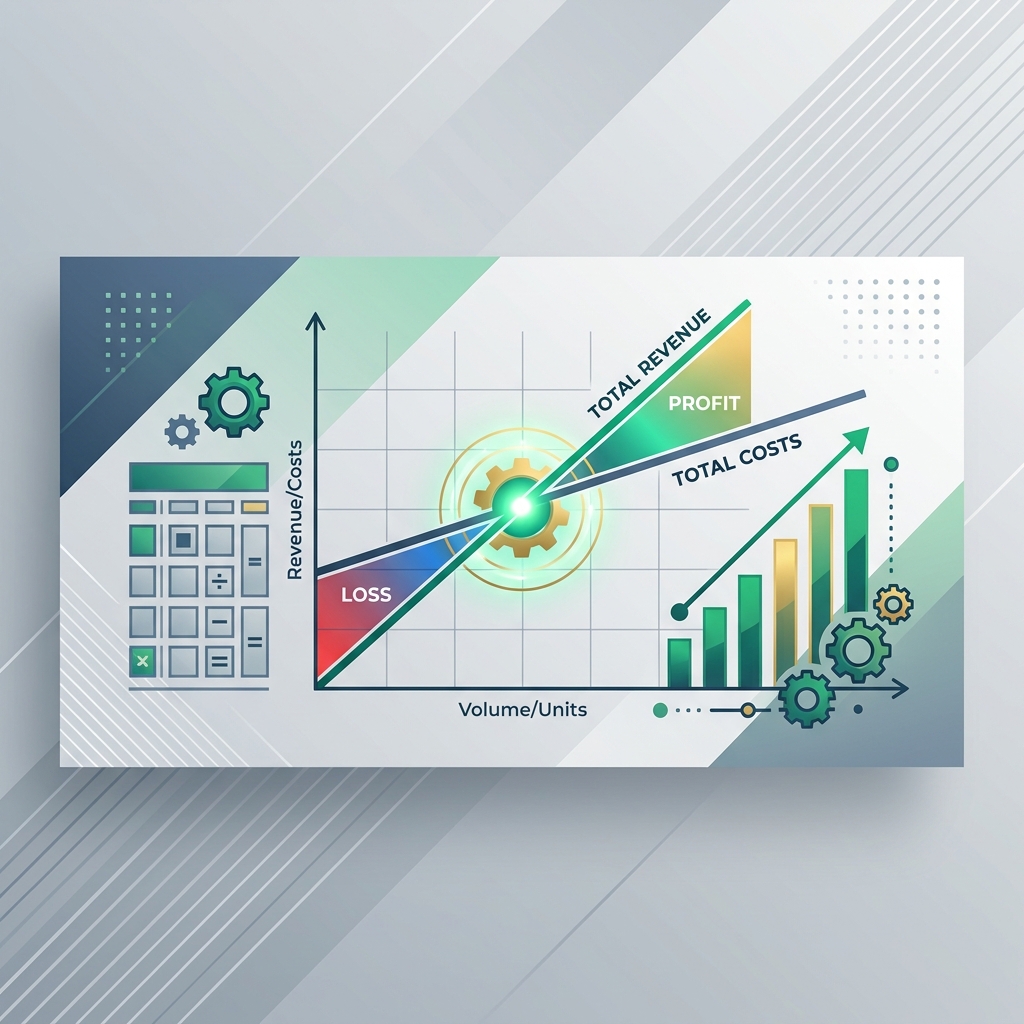
Fixed Cost Control
Rent, salaries, and insurance remain constant. Reducing them lowers your break-even point directly.
Variable Costs
Raw materials and packaging costs scale per unit. Lowering these expands unit contribution margin.
Margin of Safety
Indicates how far actual sales can slide before your company slips into loss-making territory.
Interactive Break-Even Analyzer
Cost, Volume & Profit Modeler
Fast & Precise Profitability Targets
Comprehensive Guide to Break-Even Analysis (CVP)
For any startup, small-to-medium enterprise (SME), or manufacturing company in India, profitability is the ultimate parameter of success. However, before a company can generate profits, it must clear a critical milestone: the Break-Even Point (BEP). Reaching this point means your business is no longer burning cash or operating in the red; instead, it is covering all expenses and preparing to scale.
A Break-Even Calculator 2026 is a key financial forecasting tool. It helps business owners, financial managers, and investors determine the exact volume of sales required to make zero net profit, marking the transition from loss-making to positive territory. In this comprehensive guide, we will explore the core mathematics, breakdown operational costs, and explore strategic pricing models to lower your break-even requirements.
1. What is a Break-Even Analysis?
At its core, a Break-Even Analysis is a financial calculation used to determine the sales volume (either in units or currency values) at which total business revenue equals total business expenses. At this exact point, your company has paid all expenses but has not earned any profit.
To conduct this analysis, costs are categorized into two primary categories:
- Fixed Costs (FC): These are expenses that remain constant within a specific period, independent of the production or sales volume. Examples include monthly rent, office utility bills, permanent staff salaries, software licensing subscriptions, corporate taxes, and machine depreciation.
- Variable Costs (VC): These are expenses that scale directly with production volume. If you produce zero units, your variable costs are zero. Examples include raw material purchase, packaging boxes, credit card processing fees, commission on individual sales, shipping/logistics charges, and per-piece manufacturing wages.
By mapping these costs against your product’s selling price, you can determine how many sales are required to keep the business operational.
2. The Break-Even Point Formulas & Practical Math
Determining the break-even volume requires understanding the relationship between pricing, variable costs, and fixed costs. The calculations rely on two main formulas:
Formula 1: Break-Even Point in Units
Break-Even Units = Fixed Costs / (Selling Price Per Unit – Variable Cost Per Unit)
The denominator (Selling Price Per Unit - Variable Cost Per Unit) is known as the Contribution Margin Per Unit. This represents the amount of money each sold item contributes to covering your fixed expenses. Once fixed costs are fully paid off, every subsequent unit sold generates profit.
Formula 2: Break-Even Point in Revenue (Value)
Break-Even Revenue = Break-Even Units × Selling Price Per Unit
Alternatively, you can calculate it using the Contribution Margin (CM) Ratio:CM Ratio = (Contribution Margin / Selling Price) × 100Break-Even Revenue = Fixed Costs / (CM Ratio ÷ 100).
Step-by-Step Calculation Example:
Let’s assume an Indian SME manufactures handmade leather bags. The company’s cost structure is as follows:
- Fixed Costs: ₹1,50,000 per month (covering workshop rent, admin salaries, and machinery leasing).
- Selling Price Per Bag: ₹200.
- Variable Cost Per Bag: ₹120 (covering leather, zippers, inner fabric, and worker sewing piece-rate).
Let’s run the steps:
- Calculate Contribution Margin:
₹200 (Price) - ₹120 (Variable Cost) = ₹80 per bag. - Calculate Contribution Margin Ratio:
(₹80 / ₹200) × 100 = 40%. - Calculate Break-Even Units:
₹1,50,000 (Fixed Cost) ÷ ₹80 (Contribution Margin) = 1,875 units. - Calculate Break-Even Revenue:
1,875 units × ₹200 = ₹3,75,000.
This means the workshop must sell exactly 1,875 bags every month to cover all costs. If the workshop sells 1,876 bags, it starts making a profit of ₹80. If it sells fewer than 1,875 bags, it operates at a loss.
3. Contribution Margin vs. Margin of Safety
To evaluate business risk, financial managers use two metrics derived from the break-even point:
Contribution Margin:Represents the portion of sales revenue that is not consumed by variable costs. It is the remaining money that “contributes” directly to covering fixed costs and building up operating profits.
Margin of Safety: Measures the buffer between your expected/actual sales and the break-even point. It represents the cushion your business has before it begins to lose money.
If the leather bag workshop expects to sell 3,000 bags monthly, the Margin of Safety is:3,000 (Expected) - 1,875 (BEP) = 1,125 units.
In percentage terms:(1,125 / 3,000) × 100 = 37.5%.
This means the workshop’s sales can fall by up to 37.5% before the business reaches a loss-making position. A high Margin of Safety indicates low financial risk.
4. Strategic Methods to Lower Your Break-Even Point
A high break-even point can stress a business, requiring constant high sales volumes to survive. Here are five actionable strategies to lower it:
- Optimize Fixed Expenses: Negotiate lower rent for workshops, automate repetitive admin processes, or migrate from premium office spaces to lean setups to directly reduce fixed overheads.
- Reduce Unit Variable Costs: Purchase raw materials in bulk to secure wholesale discounts, source from cost-effective suppliers, or streamline assembly processes to minimize scrap and labor waste.
- Increase the Selling Price: If your brand equity allows, raise your price. A higher price increases the contribution margin per unit, meaning you need to sell fewer items to cover fixed expenses.
- Eliminate Low-Margin Products: Focus marketing and sales efforts on high-contribution-margin items while reducing production on low-margin products.
- Shift Cost Structures: Convert fixed costs into variable costs (e.g., instead of hiring permanent sales staff, use freelance commission-based distributors). This lowers risk when sales volumes dip.
Frequently Asked Questions (FAQs)
What is a good break-even timeline for a new startup?
For most new startups, reaching the break-even point typically takes between 6 to 18 months of active operations. High-tech or capital-intensive startups may take longer due to heavy initial investments, whereas service-oriented or lean startups can break even within a few months.
How does inflation affect the break-even point?
Inflation increases both fixed costs (such as rent and admin salaries) and variable costs (raw materials and transport). If you do not raise your selling price in line with inflation, your contribution margin will shrink, pushing your break-even point higher (requiring you to sell more units to survive).
Can a service-based business use a break-even calculator?
Yes. For service businesses, the “unit” can be defined as an hour of consulting, a client project, or a monthly subscription. Variable costs are generally low (e.g., contract labor, software API costs), while fixed costs represent office space and core developer salaries.
What is the difference between accounting break-even and financial break-even?
Accounting break-even covers all operating costs and depreciation, resulting in a net profit of zero. Financial break-even takes it a step further by factoring in the cost of financing (such as interest payments on bank loans) and the minimum return expected by investors.
What should I do if my variable cost per unit exceeds the selling price?
If your variable cost exceeds your selling price, you will experience a negative contribution margin. This means your business loses more money with every unit sold, and you can never break even. You must either raise your selling price, negotiate cheaper raw materials, or revise your production process.
How often should a business perform a break-even analysis?
A business should conduct a break-even analysis at least once a year, or whenever major cost changes occur (such as rent increases, supplier rate changes, or new product introductions).
Does a lower break-even point always mean a healthier business?
Generally, yes, because it lowers operational risk and makes the business more resilient to market downturns. However, if lowering the break-even point involves sacrificing product quality or underpaying staff, it could hurt customer retention and long-term viability.
How can the break-even point help determine product pricing?
By using the calculator, you can simulate different pricing scenarios. For example, you can see if charging ₹250 instead of ₹200 reduces your required break-even target from 1,875 units to 1,200 units, helping you decide if the market can support the higher price point.

Rohit Kushwaha
Software Engineer & Creator of mysalarycalculator.in
I’m Rohit Kushwaha, a Software Engineer with 3+ years of experience in developing web applications and digital solutions. By combining technology with practical financial tools, I built mysalarycalculator.in to help Indian professionals easily understand their salary, taxes, EPF, gratuity, and take-home income.
Ask a question or share your feedback