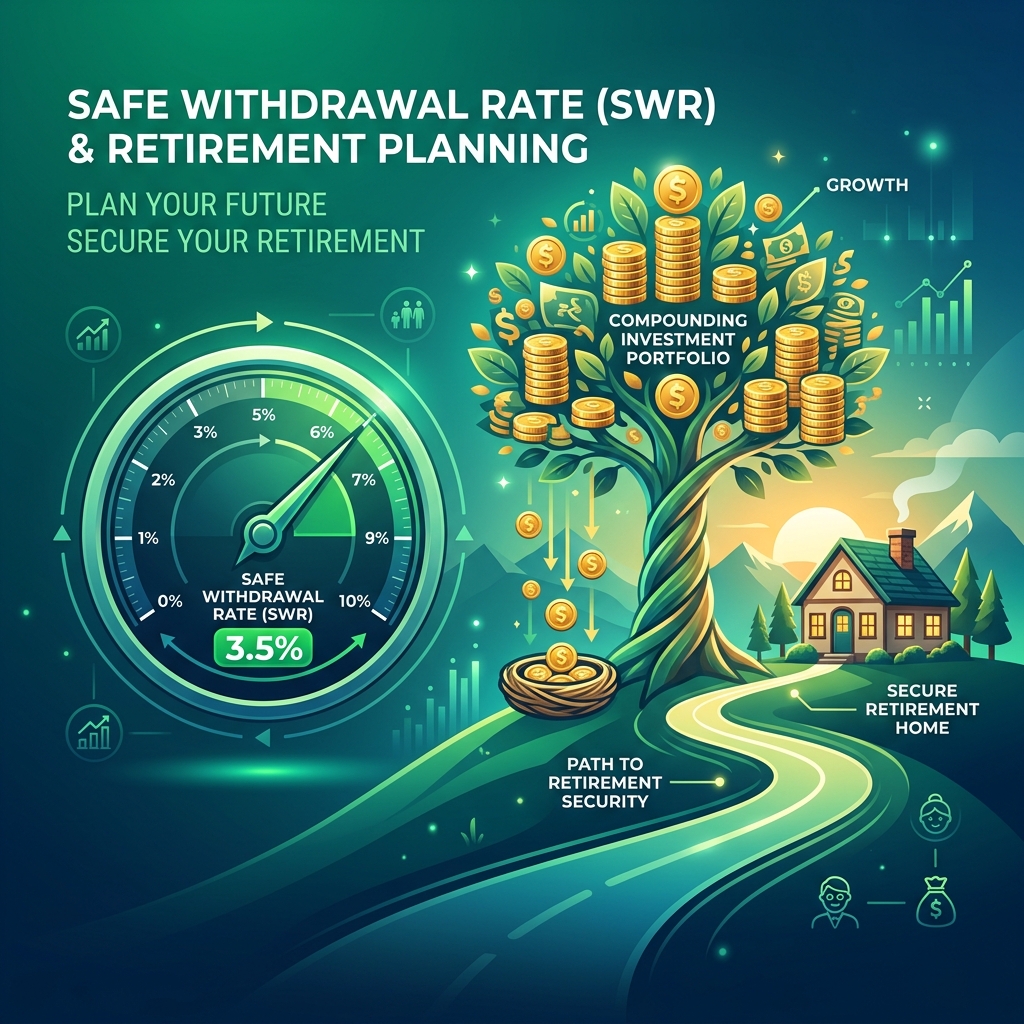
The Retirement Math: Why Safe Withdrawal Rate (SWR) is Key
Retirement planning has undergone a structural shift over the past decade. Traditionally, retirement planning was about accumulating a random target lump sum—say ₹1 Crore or ₹5 Crores—and parking it in bank Fixed Deposits or government post office schemes, living off the fixed interest. However, in today’s inflationary climate, this lazy strategy is a recipe for disaster.
The Safe Withdrawal Rate (SWR) is the percentage of your portfolio that you can withdraw in the first year of your retirement, and then adjust that nominal amount by the rate of inflation every subsequent year, with a high probability that your assets will not run out during your lifetime. SWR is the single most critical figure in retirement math. If your SWR is too aggressive, a market downturn early in your retirement will deplete your portfolio completely. If it is too conservative, you might unnecessarily force yourself to work additional years.
The Origin of the 4% Rule and Why It Fails in India
In western personal finance literature, the most famous benchmark for SWR is the **”4% Rule”**, which originated from the Trinity Study (conducted by professors at Trinity University in 1998). The study backtested historical US market returns and concluded that a retiree could withdraw 4% of their initial portfolio value in Year 1, increase that amount annually by inflation, and safely sustain a 30-year retirement across almost all historical periods.
However, copy-pasting the US 4% rule into the Indian context is highly dangerous for several reasons:
| Parameters | United States Context | Indian Retirement Context | Implication for Indian Retirees |
|---|---|---|---|
| Average Inflation | 2.0% – 3.0% | 5.5% – 7.0% | High inflation eats purchasing power rapidly. Payouts must double every 10-12 years. |
| FD/Debt Yields | 2.0% – 4.5% | 6.5% – 7.5% | Interest yields look higher in India, but post-tax real returns are often flat or negative. |
| Equity Volatility | Moderate | High (Emerging Market) | Higher growth potential but steep corrections, increasing Sequence of Returns Risk. |
| Recommended SWR | 4.0% | 3.0% – 3.5% | A lower rate provides a critical buffer against high domestic inflation. |
In India, if you start with an aggressive 4% withdrawal rate, your annual expenses will compounding quickly. If you begin with ₹4 Lakhs on a ₹1 Crore corpus, at 6% inflation, your annual withdrawal grows to ₹7.16 Lakhs by Year 10, ₹12.8 Lakhs by Year 20, and ₹22.9 Lakhs by Year 30. If your portfolio returns do not consistently outpace inflation, the compounding expenses will drag your portfolio balance down to zero before you know it.
The Silent Portfolio Killer: Sequence of Returns Risk (SRR)
Most retirement calculators assume a smooth, linear return rate (e.g., “8.5% returns every year”). In the real market, this never happens. You might get +20% in Year 1, -15% in Year 2, and +5% in Year 3. This volatility introduces a massive threat known as **Sequence of Returns Risk (SRR)**.
SRR refers to the risk that the timing of market declines early in your retirement will permanently lock in losses, as you are forced to sell depreciated assets to fund your monthly living expenses.
Consider two retirees, Retiree A and Retiree B, each starting with a **₹2 Crore corpus** and a **3.5% withdrawal rate** (₹7 Lakhs in Year 1, rising by 6% inflation). Over a 10-year period, both of their portfolios experience the exact same compound annual growth rate (CAGR) of 8.5%.
– **Retiree A** experiences a bull market in the first 3 years of retirement (+15%, +12%, +10%) followed by a bear market later. Because their portfolio grew early, the relative impact of withdrawals is small. Retiree A’s corpus grows and remains highly secure.
– **Retiree B** experiences a severe bear market in the first 3 years of retirement (-12%, -10%, +2%) followed by high returns later. Because Retiree B had to withdraw money from a rapidly shrinking corpus, they had to liquidate a much larger percentage of their assets. Even when the market recovers, Retiree B’s remaining corpus is too small to recover. Their portfolio faces depletion.
This is why your withdrawal strategy must protect against early volatility.
Smart Allocation Strategy: The Three-Bucket Framework
To immunize your retirement plan against Sequence of Returns Risk, personal finance professionals recommend implementing a **Three-Bucket Strategy**:
Bucket 1: Cash/Liquidity
**Horizon: 1 to 3 Years of Expenses**
Keep this bucket in highly liquid, risk-free assets like bank Savings Accounts, liquid mutual funds, or short-term fixed deposits. This bucket funds your immediate monthly expenses, ensuring you never have to panic-sell volatile equities to pay rent or buy groceries.
Bucket 2: Income/Debt
**Horizon: 4 to 7 Years of Expenses**
Allocate this bucket to high-quality debt mutual funds, corporate bonds, or guaranteed income options like the Senior Citizens Savings Scheme (SCSS). This bucket earns moderate returns and acts as a reservoir to refill Bucket 1 when it depletes.
Bucket 3: Growth/Equity
**Horizon: 8+ Years and Beyond**
Park the remainder of your corpus in equity mutual funds (large-cap index funds, flexi-cap funds) to compound and beat long-term inflation. Over a 10+ year period, equities historically yield double-digit returns in India, allowing your portfolio to grow and sustain the withdrawals.
SWP (Systematic Withdrawal Plan): The Tax-Efficient Payout Engine
Once you have built your buckets, how do you execute the monthly withdrawal? The most tax-efficient way to withdraw money from a mutual fund portfolio is through a **Systematic Withdrawal Plan (SWP)**.
With a bank Fixed Deposit, the entire interest earned is taxed annually under your slab rate (which can be up to 30% or more depending on your income bracket).
With an SWP from a mutual fund, every withdrawal is treated as a partial redemption of units, consisting of both principal capital and growth gains. You are only taxed on the capital gains portion, not the entire withdrawal. Furthermore, equity capital gains (both short-term and long-term) enjoy lower preferential tax rates, allowing you to pay significantly less tax and keep more of your retirement corpus compounding.

Ask a question or share your feedback