Old Tax Regime vs New Tax Regime: Which One to Choose? (FY 2025-26)
A comprehensive guide to understanding the differences between the Old and New Income Tax regimes. Calculate your exact tax liability and find out which regime saves you more money.
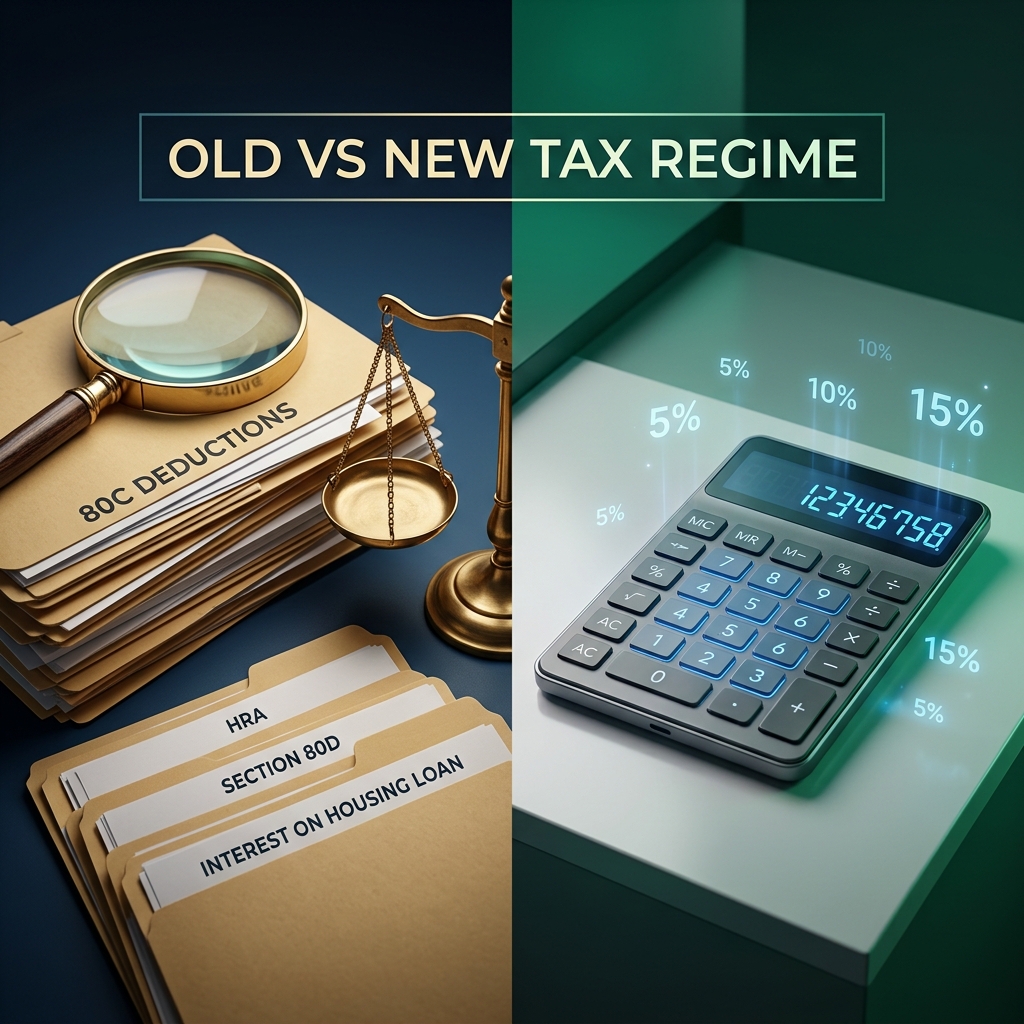
“Which tax regime is better, Old or New?” This is the single most common question taxpayers face at the beginning of every financial year. Since the government made the New Tax Regime the default from FY 2023-24 and introduced further enhancements in FY 2025-26, the debate has only intensified.
The Old Tax Regime offers around 70+ exemptions and deductions (like HRA, LTA, Section 80C, 80D, etc.) which you can use to significantly reduce your taxable income. However, the tax slab rates are steeper.
The New Tax Regime strips away almost all of these deductions (except a few like the standard deduction and employer NPS contribution) but compensates by offering much lower, simplified tax slab rates. With the recent updates, income up to ₹12 Lakhs under the New Regime can effectively be completely tax-free.
But which one actually saves you more money? Let’s break it down.
Key Differences: Old vs New Regime
| Feature | Old Tax Regime | New Tax Regime |
|---|---|---|
| Tax Slab Rates | Higher (e.g., 30% above ₹10L) | Lower, more spread out (30% only above ₹24L) |
| Standard Deduction | ₹50,000 | ₹75,000 (from FY 2025-26) |
| Section 80C (EPF, LIC) | Allowed up to ₹1.5L | Not Allowed |
| HRA & LTA Exemption | Allowed | Not Allowed |
| Home Loan Interest (Sec 24b) | Allowed up to ₹2L | Not Allowed (unless property is let out) |
| Rebate Limit (Sec 87A) | Income up to ₹5L is tax-free | Income up to ₹12L is tax-free |
Old vs New Regime Interactive Calculator
Input your salary structure and the investments you usually make. The calculator will run your numbers through both regimes simultaneously and declare the winner.
Tax Regime Optimizer
FY 2025-26 (AY 2026-27)
1. Income Components
2. Deductions (For Old Regime)
When is the New Tax Regime Better?
The New Tax Regime is the default option and is overwhelmingly better for the vast majority of young professionals and those who do not have heavy financial commitments like home loans.
- Income up to ₹12.75 Lakhs: Thanks to the ₹75,000 standard deduction and the Section 87A rebate, anyone earning a gross salary up to ₹12,75,000 pays zero tax under the New Regime without needing a single rupee in 80C investments.
- Low Investment Appetite: If you prefer to invest your money in stocks, business, or simply want high liquidity rather than locking it up in PPF or 5-year FDs, the New Regime gives you more take-home pay.
- No House Rent/Home Loan: If you live in your own house without a loan, or live with parents and don’t pay rent, you can’t claim HRA or 24(b). The New Regime’s lower tax slabs heavily benefit you.
When does the Old Tax Regime still make sense?
Despite the government’s push towards the New Regime, the Old Regime remains highly lucrative for taxpayers in higher income brackets who maximize their eligible deductions.
- High Deductions Profile: If your total deductions (HRA + 80C + 80D + 24b + NPS) exceed ₹3.75 Lakhs to ₹4.25 Lakhs, the Old Regime usually begins to mathematically outperform the New Regime.
- Active Home Loans: If you are paying EMIs for a home loan, Section 24(b) gives you a flat ₹2,00,000 deduction on the interest component. Coupled with the ₹1.5L principal deduction under 80C, this provides a massive tax shield only available in the Old Regime.
- High Rent Payers in Metro Cities: If you pay ₹30,000+ per month as rent in a metro city and receive a substantial HRA component, the HRA exemption alone can pull your taxable income down significantly under the Old Regime.
Frequently Asked Questions (FAQ)
Which is better, old or new tax regime?
There is no one-size-fits-all answer. As a general rule: If your gross salary is up to ₹12.75 Lakhs, the New Regime is overwhelmingly better as your tax is zero. If your salary is higher, the Old Regime is better ONLY IF your total deductions (like 80C, HRA, Home Loan) exceed approximately ₹4,00,000.
What is the old regime and the new regime?
The Old Tax Regime allows taxpayers to claim over 70 deductions and exemptions (like HRA, LTA, 80C, 80D) to reduce taxable income, but applies higher tax slab rates. The New Tax Regime offers lower, simplified tax slab rates but removes almost all deductions and exemptions.
Which tax regime is better, old or new for 30 lakhs?
For a ₹30 Lakh salary, the New Regime is usually better if you do not have heavy deductions. In the New Regime, tax on ₹30L is around ₹5.4 Lakhs. To beat this in the Old Regime, you would need to claim deductions (80C, HRA, Home loan interest) exceeding ₹4,25,000. If your deductions are lower than that, stick to the New Regime.
Is 12 lakh tax free for old regimes?
No. In the Old Regime, the tax-free limit (where Section 87A rebate applies) is only up to a taxable income of ₹5 Lakhs. To make a ₹12 Lakh salary tax-free in the Old Regime, you would need to claim ₹7 Lakhs worth of deductions (like 50k standard deduction, 1.5L 80C, 2L home loan, 3L HRA), which is practically difficult. In the New Regime, ₹12 Lakhs is completely tax-free.
Can I switch between the old and new tax regimes every year?
If you are a salaried employee without any income from business or profession, you can switch between the old and new tax regimes every year. However, if you have business/professional income, you get only one chance in your lifetime to switch back to the old regime.
Is the standard deduction of ₹75,000 available in both regimes?
For FY 2025-26, the standard deduction has been increased to ₹75,000 in the New Tax Regime. However, it remains capped at ₹50,000 in the Old Tax Regime.
Do I need to submit investment proofs if I choose the New Tax Regime?
No. Because the New Tax Regime does not allow deductions under Section 80C, 80D, or HRA exemptions, you do not need to submit rent receipts, LIC premium receipts, or PPF proofs to your employer to save tax.
What is the “Default” tax regime?
From FY 2023-24 onwards, the New Tax Regime has been set as the default regime. This means if you do not explicitly inform your employer or choose the old regime while filing your ITR, your tax will be calculated according to the New Regime slabs.

Rohit Kushwaha
Software Engineer & Creator of mysalarycalculator.in
I’m Rohit Kushwaha, a Software Engineer with 3+ years of experience in developing web applications and digital solutions. By combining technology with practical financial tools, I built mysalarycalculator.in to help Indian professionals easily understand their salary, taxes, EPF, gratuity, and take-home income.
Ask a question or share your feedback