8th Pay Commission Fitment Factor 2026: Expected Salary Hike, Pension Increase & Latest Updates
Introduction
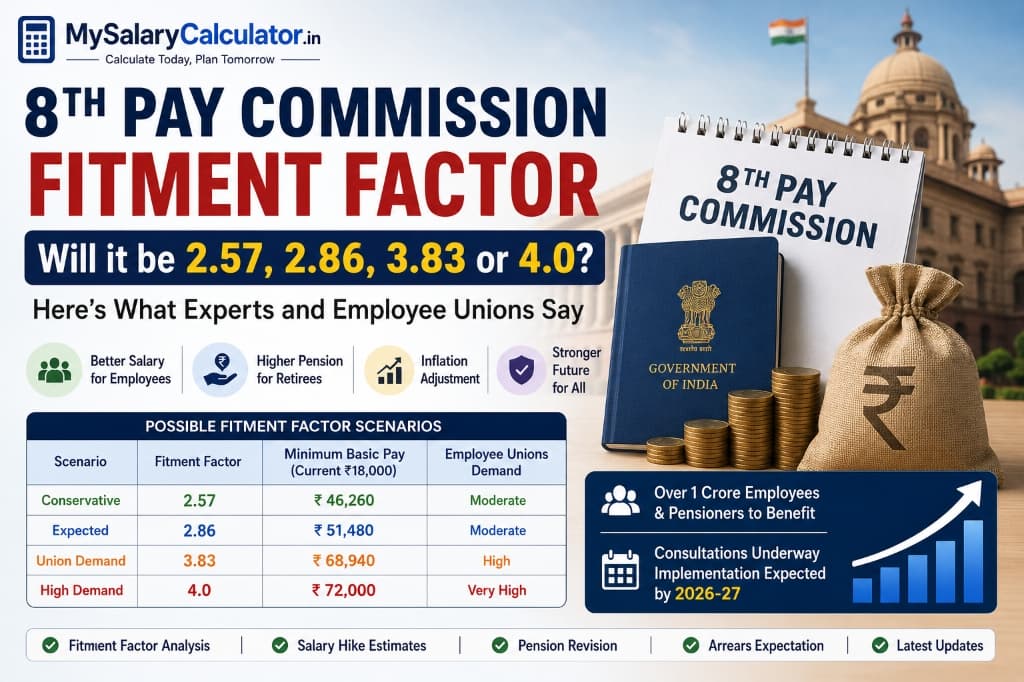
The 8th Pay Commission is one of the most anticipated developments for central government employees and pensioners. With discussions around fitment factors ranging from 2.57 to 4.0, employees are eager to know how much their salaries and pensions could increase. This article explains the expected fitment factor, projected salary hikes, pension revisions, and the latest official updates.
Key Highlights
- 8th Pay Commission consultations are currently underway.
- Fitment factor discussions range from 2.57 to 4.0.
- Employee unions are demanding a fitment factor above 3.0.
- Salary and pension revisions may impact over 1 crore beneficiaries.
- Final recommendations are expected after stakeholder consultations.
What is the 8th Pay Commission?
The Central Pay Commission (CPC) is set up by the Government of India every ten years to review and recommend changes to the salary structure, allowances, benefits, pensions, and overall service conditions of central government employees and military personnel. The commission examines the fiscal health of the government alongside changes in living standards and inflation before presenting a revised pay matrix. The recommendations made by the 8th Pay Commission will directly affect more than 48 lakh central government employees and over 68 lakh pensioners.
What is a Fitment Factor?
The fitment factor is a standard multiplier used to revise the existing basic pay and pension from the previous Pay Commission structure to the new one. It ensures a uniform upward adjustment of salaries across all pay bands.
Calculation Formula
Example Calculation:
- Current Minimum Basic Pay: ₹18,000
- Applied Fitment Factor: 2.57
- Revised Minimum Basic Pay: ₹18,000 × 2.57 = ₹46,260
8th Pay Commission Fitment Factor: Expected Range
The government is considering multiple multiplier options based on inflation benchmarks, union representations, and financial resources. Here are the four primary scenarios being discussed:
Scenario 1: Fitment Factor 2.57
Matches the baseline 7th Pay Commission multiplier. If adopted, it would set the new minimum basic pay at ₹46,260.
Scenario 2: Fitment Factor 2.86
Formulated to adjust for cumulative inflation since 2016. If implemented, this sets the minimum basic pay at ₹51,480.
Scenario 3: Fitment Factor 3.83
A high multiplier recommended by employee unions to match economic growth and cost-of-living indices, leading to a minimum pay of ₹68,940.
Scenario 4: Fitment Factor 4.0
The maximum demand put forth by employee associations, aiming for a rounded minimum basic salary of ₹72,000.
Expected Salary Hike Table
The table below outlines how different existing basic pay rates would translate under the various proposed fitment factor scenarios:
| Current Basic | 2.57 Factor | 2.86 Factor | 3.83 Factor | 4.0 Factor |
|---|---|---|---|---|
| ₹18,000 | ₹46,260 | ₹51,480 | ₹68,940 | ₹72,000 |
| ₹25,500 | ₹65,535 | ₹72,930 | ₹97,665 | ₹1,02,000 |
| ₹35,400 | ₹90,978 | ₹1,01,244 | ₹1,35,582 | ₹1,41,600 |
Employee Union Demands
Joint employee action committees and federations are actively negotiating with representatives to secure better terms. Their primary demands include:
- Higher Fitment Factor: Setting the multiplier minimum at 3.0 to meet current living costs.
- Improved Minimum Pay: Upgrading the minimum starting basic salary to ensure a decent standard of living.
- Better Pension Revision: Raising the base pension multiplier proportionally.
- Inflation-linked Salary Correction: Structuring DA formulas to adjust quicker in periods of high food inflation.
- Higher Family Pension: Enhancing the basic payouts offered to surviving family members of retired officials.
Why Are Employees Demanding a Higher Fitment Factor?
Rising Inflation: Over the last decade, employees have faced double-digit price increases in essential areas like housing, healthcare, higher education, food commodities, and domestic transport. A lower fitment factor would reduce employees' real purchasing power.
Long Revision Cycle: Pay commissions are typically established only once every ten years. Because the resulting pay structures must last for a decade, employee unions argue that a generous starting multiplier is crucial to safeguard employees against future inflation.
8th Pay Commission Pension Revision
The 8th Pay Commission is also expected to reform the retirement benefits system, focusing on minimum pension revisions and age-based multipliers to better support older retirees.
| Age Group | Proposed Pension Base |
|---|---|
| 65 Years | 70% of Last Pay Drawn |
| 70 Years | 75% of Last Pay Drawn |
| 75 Years | 80% of Last Pay Drawn |
| 80 Years | 85% of Last Pay Drawn |
| 85 Years | 90% of Last Pay Drawn |
| 90+ Years | 100% of Last Pay Drawn |
Latest 8th Pay Commission Updates
Recent Developments: The official deadline for submitting representations and stakeholder memorandums has been extended to allow unions to prepare detailed cases. Regional meetings are actively taking place in major cities to gather data directly from state representatives. The Department of Expenditure is coordinating with pay experts to model the budget impact under different pay scenarios.
Expected Implementation Timeline
| Stage | Status |
|---|---|
| Commission Formation | Completed |
| Public Consultation | Ongoing |
| Stakeholder Meetings | Ongoing |
| Draft Recommendations | Expected 2027 |
| Implementation Date | To Be Announced |
Impact on Government Employees
A revised pay matrix will impact employee categories differently depending on their current pay levels. Lower pay level bands (Levels 1 to 5) will see the highest proportional hike in take-home salaries relative to their current baseline. Meanwhile, mid to senior pay levels (Levels 6 to 12) will benefit from revised allowances, including HRA and transport allowances, which are calculated as percentages of the basic pay.
Impact on Pensioners
Retired employees stand to benefit significantly from the 8th Pay Commission's recommendations. The pension revision multiplier will boost the monthly basic pension amount.
Additionally, the basic family pension rates will be upgraded. The monthly Dearness Relief (DR) percentage will be reset to match the revised basic pension scale. The government is also looking into a retroactivity model to address retiree arrears.
Will Employees Receive Arrears?
Whether employees receive arrears depends on the official implementation date announced by the Cabinet. If the pay scale is implemented retrospectively from January 1, 2026, but officially cleared later, employees and pensioners will receive lump-sum arrear payments for the difference. However, if the government decides to apply the recommendations prospectively from the notification date, no arrears will be disbursed.
Expert Opinions
Financial analysts and policy specialists have mixed reviews. While pay hikes will support employee welfare and increase consumer demand in the domestic market, economists caution that a high fitment factor could put pressure on the national budget. The government must balance employee welfare demands with fiscal sustainability and general infrastructure expenditure requirements.
Frequently Asked Questions (FAQ)
What is the expected fitment factor in the 8th Pay Commission?
While employee associations are demanding a factor of 3.83 or 4.0, industry analysts suggest the government may settle on a moderate fitment factor between 2.86 and 3.0 to manage fiscal pressure.
Will DA be merged with basic pay?
Under the current pay structure, accumulated DA is expected to be merged into basic pay when the new 8th Pay Commission recommendations are implemented.
When will the 8th Pay Commission be implemented?
The commission is in the consultation phase. Draft recommendations are expected by late 2027, and implementation schedules will be finalized by the cabinet following submission.
Will pensioners benefit from the 8th Pay Commission?
Yes, pensioners will benefit through proportionate increases in basic pension, family pension revisions, and adjusted age-based benefits.
How much salary increase is expected?
The actual increase depends on your pay level. With an expected factor of 2.86, salaries will increase by about 25–30% on basic pay.
Will arrears be paid?
Arrears will be paid if the cabinet decides to implement the recommendations retrospectively.
Is the fitment factor applicable to pensioners?
Yes. The same fitment factor is applied as a multiplier to the current basic pension to calculate the revised pension.
What is the minimum salary expected under the 8th Pay Commission?
Depending on the fitment factor approved (between 2.57 and 4.0), the minimum salary is expected to be between ₹46,260 and ₹72,000.
Conclusion
The final fitment factor of the 8th Pay Commission will play a crucial role in determining salaries and pensions for millions of central government employees and pensioners. While estimates range from 2.57 to 4.0, the final decision will depend on inflation, fiscal considerations, and recommendations from stakeholder consultations. Employees should follow official updates closely as the Commission progresses toward its final report.
Disclaimer: All salary, pension, and fitment factor estimates discussed in this article are based on proposals, expert opinions, and publicly available information. Final recommendations will be announced by the Government of India after completion of the 8th Pay Commission process.

Rohit Kushwaha
Software Engineer & Creator of mysalarycalculator.in
I'm Rohit Kushwaha, a Software Engineer with 3+ years of experience in developing web applications and digital solutions. By combining technology with practical financial tools, I built mysalarycalculator.in to help Indian professionals easily understand their salary, taxes, EPF, gratuity, and take-home income.
Comments & Discussion (0)
Join the Conversation
No comments yet. Be the first to start the discussion!