Home Loan Eligibility Calculator 2026: Calculate Maximum Loan Amount
Determine your maximum home loan eligibility under Indian banking standards. Estimate borrowing capacity based on FOIR, salary, existing EMIs, and co-applicant buffers.
Quick Answer
How much home loan can I get on my salary?
Your maximum home loan eligibility is calculated using your FOIR (Fixed Obligations to Income Ratio). For a standard ₹75,000 monthly salary with no existing EMIs, your maximum eligible home loan is approximately ₹43.6 Lakhs (modeled at 8.5% interest for 20 years).
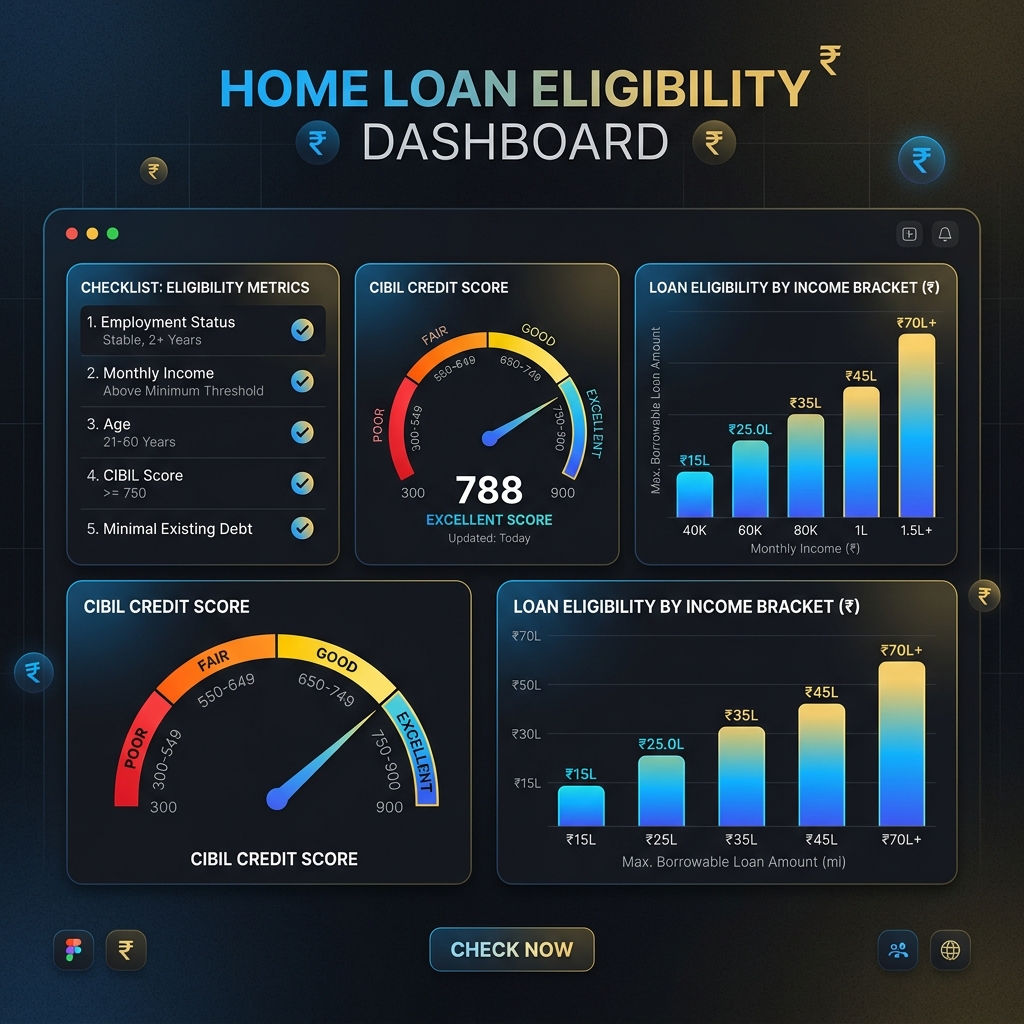
FOIR Ceiling Limits
Banks restrict monthly obligations to 40%-60% of income. Reducing personal loans expands home loan eligibility.
Interest Rate Leverage
Lower interest rates drop monthly EMIs, directly boosting the maximum principal amount you can borrow.
Tenure Extension
Extending the loan tenure to 20 or 30 years spreads out principal repayments, jumping your borrowing limit.
What is FOIR?
FOIR (Fixed Obligations to Income Ratio) restricts your debt burden. Banks limit your total monthly loan payments (including current EMIs + the new home loan) to roughly 50% of your net monthly salary. Use the calculator below to dynamically view your FOIR allocations.
Borrowing Capacity Modeler
Mortgage Eligibility Modeler
Fast & Precise FOIR Calculation
How to Calculate Home Loan Eligibility Based on Salary
The most critical component of securing a home loan is proving your repayment capability. Banks look at your gross monthly salary and carve out living expenses. The leftover disposable income forms your true borrowing power.
1. Bank FOIR (Fixed Obligations to Income Ratio) Ranges
Banks mandate that you can only designate a strict percentage of your salary toward loans. Here is how standard FOIR scales with income:
- Salary < ₹30,000: Debt limit capped at 40% of income.
- Salary ₹30,000 – ₹50,000: Debt limit at 50% of income.
- Salary ₹50,000 – ₹1,00,000: Debt limit rises to 55%.
- Salary > ₹1,00,000: Max debt limit reaches 60%.
2. Property Value Restrictions (LTV Ratio)
Regardless of how high your salary is, lenders will never finance 100% of the property value. The Loan to Value (LTV) limits are enforced strictly:
- Under ₹30 Lakhs: Max 90% LTV (10% down payment required).
- ₹30 Lakhs to ₹75 Lakhs: Max 80% LTV (20% down payment required).
- Above ₹75 Lakhs: Max 75% LTV (25% down payment required).
3. How to Increase Your Borrowing Capacity
You can easily expand your home loan limit by adding a co-applicant (spouse or parent) to pool salaries together. Additionally, aggressively paying off small personal loans drops your existing obligations, opening up more FOIR bandwidth purely for your new mortgage.
Frequently Asked Questions
What is FOIR and how does it determine my home loan eligibility?
Can a joint home loan increase my borrowing capacity?
How does my CIBIL score affect my eligibility?
What is the LTV ratio and how does it impact down payments?
Does choosing a longer loan tenure increase eligibility?
Can I get a home loan if I have an outstanding car or personal loan?

Rohit Kushwaha
Software Engineer & Creator of mysalarycalculator.in
I’m Rohit Kushwaha, a Software Engineer with 3+ years of experience in developing web applications and digital solutions. By combining technology with practical financial tools, I built mysalarycalculator.in to help Indian professionals easily understand their salary, taxes, EPF, gratuity, and take-home income.
Ask a question or share your feedback