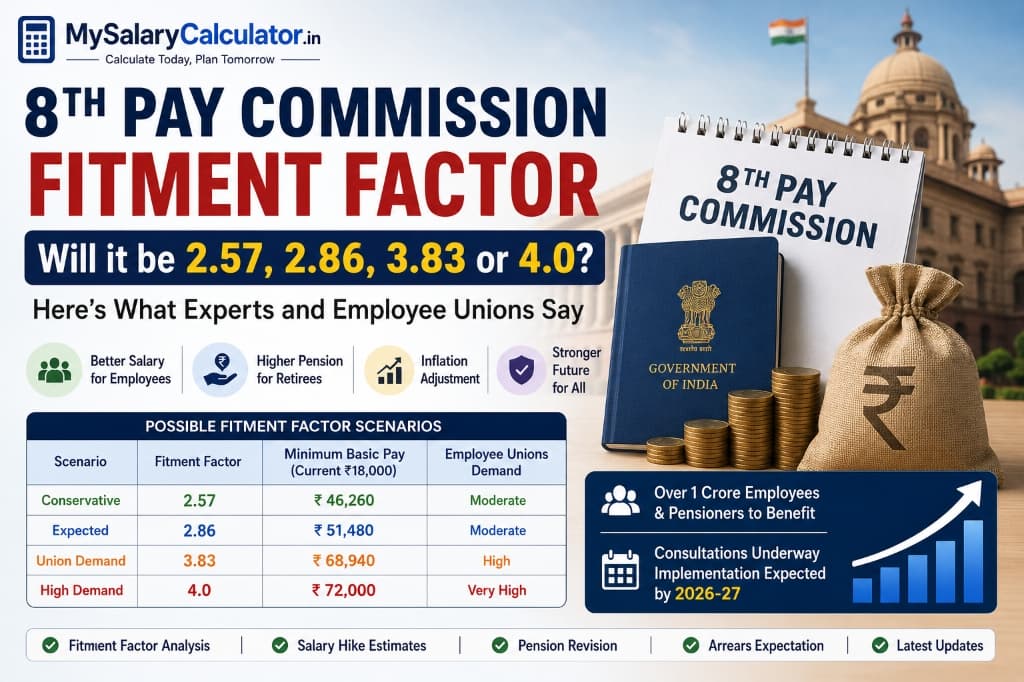
As deliberations for the 8th Central Pay Commission (CPC) intensify, major government employee confederations, defence worker unions, and pensioner bodies have formally presented their demands. Central to all memorandums is the fitment factor—the multiplier that determines basic pay increases across all 18 levels of the pay matrix.
While initial economic projections anticipated a conservative fitment factor between 2.00 and 2.57, employee federations have demanded significantly higher multipliers ranging from 3.61 to 4.00 to address decade-long inflation and real cost-of-living increases.
1. Why Employee Unions Demand Fitment Factors from 3.61 to 4.00
The rationale presented by staff associations to the 8th Pay Commission relies on three primary economic arguments:
- Dr. Wallace Aykroyd Formula (15th ILC Norms): The standard minimum wage formula calculates dietary requirements (2,700 calories per adult consumption unit), 66 meters of clothing per year, housing rent (minimum 15% of basic), education, healthcare, and social contingencies. Current retail prices translate to a minimum basic wage requirement exceeding ₹65,000 per month.
- Inflation Erosion Since 2016: Cumulative inflation in urban housing, specialized medical treatment, and quality education has outpaced standard CPI-IW dearness allowances.
- Compensation Parity: Closing the wage disparity between Central Government executive cadres and Public Sector Undertakings (PSUs) / banking sector executives.
2. Union-Wise Fitment Factor Proposals Submitted
Calculated based on field staff hardship indices and real urban consumption baskets.
A comprehensive calculation using revised 15th ILC norms and national per capita income growth.
Demands complete neutralization of inflation and a doubling of effective purchasing power.
3. 7th CPC vs 8th CPC Pay Matrix under 3.61, 3.833 & 4.00
Comparative salary table for all Pay Matrix levels under the proposed multipliers:
| Level & Role | 7th CPC Basic | At 3.61 (MSA) | At 3.833 (NC JCM) | At 4.00 (BPMS) |
|---|---|---|---|---|
| Level 1MTS / Group D / Peon | ₹18,000 | ₹64,980 | ₹68,994 | ₹72,000 |
| Level 2LDC / Junior Clerk | ₹19,900 | ₹71,839 | ₹76,277 | ₹79,600 |
| Level 3Constable GD / Postman | ₹21,700 | ₹78,337 | ₹83,176 | ₹86,800 |
| Level 4Head Constable / UDC | ₹25,500 | ₹92,055 | ₹97,742 | ₹1,02,000 |
| Level 5ASI / Senior Auditor | ₹29,200 | ₹1,05,412 | ₹1,11,924 | ₹1,16,800 |
| Level 6Sub-Inspector / TGT Teacher | ₹35,400 | ₹1,27,794 | ₹1,35,688 | ₹1,41,600 |
| Level 7Inspector / PGT Teacher | ₹44,900 | ₹1,62,089 | ₹1,72,102 | ₹1,79,600 |
| Level 8Assistant Accounts Officer | ₹47,600 | ₹1,71,836 | ₹1,82,451 | ₹1,90,400 |
| Level 9Section Officer | ₹53,100 | ₹1,91,691 | ₹2,03,532 | ₹2,12,400 |
| Level 10Assistant Commandant / SDM | ₹56,100 | ₹2,02,521 | ₹2,15,031 | ₹2,24,400 |
| Level 11Deputy Secretary / Joint Director | ₹67,700 | ₹2,44,397 | ₹2,59,494 | ₹2,70,800 |
| Level 12Director / DIG Police | ₹78,800 | ₹2,84,468 | ₹3,02,040 | ₹3,15,200 |
| Level 13Joint Secretary / IG Police | ₹1,23,100 | ₹4,44,391 | ₹4,71,842 | ₹4,92,400 |
| Level 14Additional Secretary / ADG Police | ₹1,44,200 | ₹5,20,562 | ₹5,52,719 | ₹5,76,800 |
| Level 15Secretary to GoI / DGP | ₹1,82,200 | ₹6,57,742 | ₹6,98,373 | ₹7,28,800 |
| Level 17Special Secretary / Army Commander | ₹2,25,000 | ₹8,12,250 | ₹8,62,425 | ₹9,00,000 |
| Level 18Cabinet Secretary of India | ₹2,50,000 | ₹9,02,500 | ₹9,58,250 | ₹10,00,000 |
4. Impact on Pensioners (Minimum Pension & Family Pension)
Under Central Civil Services (Pension) Rules, basic pension is fixed at 50% of the last basic pay drawn, while family pension is fixed at 30%:
5. Union Demands (3.61–4.00) vs Government / Expert Estimates (2.00–2.57)
| Parameter | Union Demands | Expert / Govt Projections |
|---|---|---|
| Fitment Factor Range | 3.61 to 4.00 | 2.00 to 2.57 (likely ~2.28) |
| Minimum Basic Pay (Level 1) | ₹64,980 – ₹72,000 | ₹36,000 – ₹41,040 |
| Fiscal Impact on Union Budget | High (~₹3.5 Lakh Crore) | Manageable (~₹1.8 Lakh Crore) |
| Effective Implementation Date | January 1, 2026 | January 1, 2026 (with Arrears) |
Frequently Asked Questions (FAQs)

Rohit Kushwaha
Software Engineer & Creator of mysalarycalculator.in
I'm Rohit Kushwaha, a Software Engineer with 3+ years of experience in developing web applications and digital solutions. By combining technology with practical financial tools, I built mysalarycalculator.in to help Indian professionals easily understand their salary, taxes, EPF, gratuity, and take-home income.
Comments & Discussion (0)
Join the Conversation
No comments yet. Be the first to start the discussion!